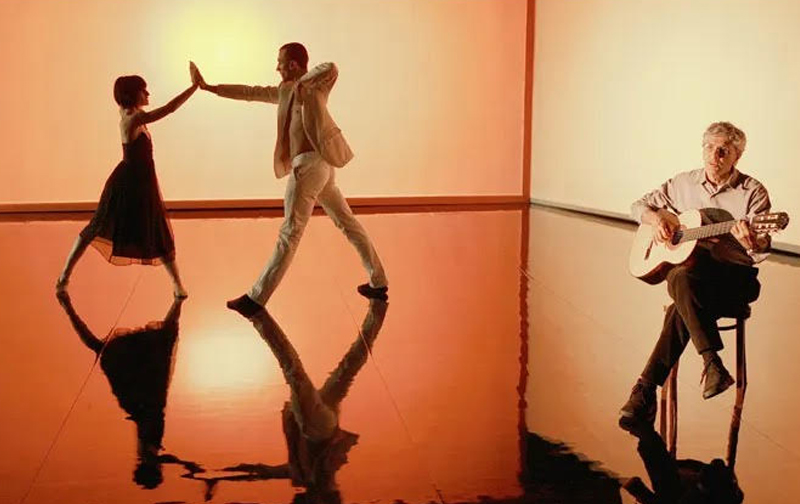
Carlos Saura’s cinema unfolds like a grand stage where reality and artifice dance in perpetual interplay. Across an oeuvre spanning six decades, the Spanish auteur developed a visual language that is at once academic in its rigor and poetic in its sensuality. His films, from the stark allegories crafted under Francisco Franco’s dictatorship to the vibrant flamenco musicals of his later years, reveal an artist fascinated “by tradition, history and the way fantasy and artifice intersect with reality” . In Saura’s world, costume, set design, lighting, and cinematography are not mere production elements – they are active narrators in a symbolic dialogue between the past and the present, between Spain’s cultural memory and its modern identity. His work has been hailed as both “daring, vivid use of colour and symbolism” and adept at exposing social realities through realism , earning Saura a reputation as “the father of modern Spanish cinema” whose innovative touch echoes in the films of Pedro Almodóvar and others . Each film is a carefully composed canvas where fashion and costume become emblems, lighting sculpts movement, and stage-like settings blur the line between theater and cinema, all in service of a deeply felt exploration of Spanish identity and creative expression.
Saura’s early films emerged in the 1960s under the shadow of authoritarian rule, when censorship forced filmmakers into elliptical storytelling. He responded with an allegorical visual style, embedding political critique in metaphor and symbolism. His breakout La caza (The Hunt, 1966), for example, reduced narrative to “very minimal elements—four characters hunting in a desolate landscape” , yet it constructed a potent allegory of Spain’s Civil War trauma. Under the blistering sun of rural Spain, white bleached bones and dead rabbits become totems of buried violence, the stark desert setting mirroring a society “suspended in a moral void” . The film’s realism (shot on location in unforgiving heat) is harnessed for symbolic ends: the sweat-stained hunting costumes of the men and the harsh natural lighting speak to the brutality lingering beneath a veneer of civility. A ferocious aesthetic of cruelty pervades the film – close-ups of insects crawling on carrion, the glare of sunlight on rifles – all choreographed cinematically to imply the lingering specter of fratricidal war. Such imagery required subtlety under censorship, and Saura became “a prime example of how severe restrictions can bring out the art and cunning in a film director… packed with metaphors and a magic realist blur of truth and fantasy” . The need to evade Franco’s censors fostered in Saura a “dramatic subtlety, delicacy and psychological resonance” that would define his early style. Costumes, props, and settings took on double meanings: a hunting outfit could signify militarism; a barren set could evoke an emotional landscape. In these early works, the visual elements became a coded language, expressing what could not be spoken aloud in Franco’s Spain.
As the 1960s progressed, Saura increasingly centered his films on the inner dramas of individuals caught between tradition and modernity. In Peppermint Frappé (1967) – Saura’s first collaboration with actress Geraldine Chaplin – fashion and costume design are integral to the film’s psychological games. The protagonist, Julián, is a staid, repressed man who becomes obsessed with an old friend’s young wife, Elena. Saura visually contrasts Elena’s cosmopolitan glamour with the provincial demureness of Julián’s assistant, Ana (also played by Chaplin). Through an unsettling Pygmalion-like obsession, Julián attempts to transform Ana into Elena’s double – an act achieved quite literally through costume and styling. He “begins to slowly mold [Ana] in the image of Elena until she completely resembles [her]… down to the blonde hair and fake eyelashes” . The film pointedly opens with images from fashion magazines being cut out and assembled in Julián’s scrapbook , immediately signaling how fashion and media ideals of womanhood fuel his fixation. “It is that notion of woman as object, which fashion magazines show in a very clear way… In Peppermint Frappé it’s… clear because it contains the myth of the woman-object held by the traditional man” Saura explained . Indeed, Elena is often costumed in chic 60s attire – bold prints, stylish mini-dresses – epitomizing a liberated modern femininity that tantalizes and terrifies Julián. By contrast, Ana initially appears in drab nurse uniforms and plain clothes, a blank canvas for Julián’s projections. As he refashions her – a blonde wig here, a layer of makeup there – the costume changes become acts of possession, turning Ana into a living doll representing Julián’s ideal. In one disturbing sequence, Julián dresses Ana in an identical green dress that Elena wore, completing the eerie duplication. The transformation is filmed with fetishistic detail: close-ups of Ana’s newly lacquered nails, the artificial blonde hair catching the light, the exaggerated eyelashes blinking back vacant obedience. Through these visual details, Saura lays bare the film’s subtext: the costumes are not merely clothes, but fetishes laden with power. As a critic observed, Saura integrates such motifs of “sexual fetishism… and a marked theatricality” in these bourgeois dramas . The characters literally wear their obsessions, and clothing becomes a battlefield between repression and desire. This interplay of fashion and identity in Peppermint Frappé not only advances the narrative of obsession but also critiques the “fixed images” of women ingrained in the Spanish bourgeois psyche . By the film’s chilling climax – which recalls Hitchcock’s Vertigo in its portrait of destructive idealization – the audience has witnessed costume as a tool of transformation and control, an external wrapping that reveals the twisted inner yearnings of Saura’s Franco-era Spain.
Saura’s partnership with Geraldine Chaplin in this period led to a series of films in which performance and masquerade were recurrent themes, often reflecting the claustrophobia of the Spanish bourgeoisie. In La madriguera (Honeycomb, 1969), Chaplin portrays Teresa, a restless housewife who alleviates her ennui by playing elaborate fantasy games with her husband in their home. When Teresa inherits antique furniture and mementos from her childhood – ornate armoires, old toys, and boxes of vintage clothes – the tidy modern home is gradually transformed into a stage for her role-playing rituals . Saura and Chaplin co-wrote this absurdist psychological drama, which becomes a dark domestic theater of shifting identities. The inherited costumes and fabrics serve as catalysts for Teresa’s fantasies: she dons an old wedding dress and suddenly speaks as an innocent girl; a drab mourning shawl over her shoulders and she inhabits a stern governess; a playful flamenco skirt from the attic and she twirls into a flirtatious coquette. Indeed, Chaplin’s performance “involves throughout the touching and wearing of textiles, fabrics, and clothes, expressive objects which become intertwined with questions of interiority” . In scene after scene, Saura films Chaplin amid billowing curtains or draped in rich fabric, visually suggesting how costumes unleash buried emotions within the character. At one moment, Teresa strings a curtain around herself like a mantilla, her face oscillating between childish glee and ominous detachment, lit by Saura in half-shadow to blur the line between Teresa’s reality and her self-imposed fiction. The modern house, designed with austere lines and broad windows, gradually feels like a cloistered stage: “the sense of a limited and clearly defined space gives the film a theatrical feel, as do the curtains… overall it is quite a stagey production” . Saura underscores this by frequently framing action in doorways or behind semi-transparent veils, as if presenting a play to the audience. The camera watches from fixed positions, then suddenly cuts to striking close-ups of Chaplin’s face as she slips between personas. The very act of dressing up becomes the narrative – the plot, such as it is, consists of these games of make-believe spiraling out of control. As in Peppermint Frappé, Saura uses costumes here to explore identity’s fluidity and the performative nature of social roles. Teresa’s increasingly extravagant masquerades highlight her psychological fragmentation; each outfit change is accompanied by subtle shifts in lighting and color to cue the mood. Warm, domestic lamplight turns to cold blue tones when she role-plays a somber scene from her past, then to romantic golden hues as she enacts a seductive fantasy. In the confined space of the home set (all interiors and a garden), Saura employs lighting like a theatrical designer, heightening the emotional contours of each “act” Teresa stages. By the film’s end, as the couple’s role-play escalates to dangerous extremes, the viewer has been drawn into an unsettling metatheatrical experience – one that prefigures Saura’s later fascination with blending stage and cinema. Honeycomb’s design and cinematography already blur reality and performance, with Chaplin “clearly delineat[ing] the different women she performs through gesture and body language” , while the house itself becomes a pliable set. In this way, Saura used the tools of costume and set not only to reflect his characters’ inner lives but to comment on the artifice inherent in daily social roles. It was a theme that would evolve and expand dramatically in his post-Franco works.
By the early 1970s, Saura was acclaimed as a leading voice of Nuevo Cine Español, the new wave of Spanish cinema, and he continued to push against aesthetic boundaries even as Spain remained under dictatorship. Films like El jardín de las delicias (The Garden of Delights, 1970), Ana y los lobos (Anna and the Wolves, 1973), and La prima Angélica (Cousin Angelica, 1974) employed dream sequences, memory flashbacks, and surreal symbolism to critique the hypocrisy and decay of Spanish bourgeois and patriarchal structures. “Symbols are what matter!” exclaims a character in The Garden of Delights, neatly summarizing Saura’s expressive strategy during this era . His cinema became increasingly metaphoric: a banquet table laden with rotting food might stand in for the moral rot of the elite; a child’s game played in faltering light could evoke the lost innocence of a nation. Saura’s mise-en-scène in these films was often deliberately artificial or theatrical: in The Garden of Delights, the protagonist’s amnesia triggers staged tableaux of his past, with family members appearing like actors on a set, lit by flickering memory. He would film these sequences in stylized lighting – e.g., a stark spotlight isolating a character in an otherwise dark void – emphasizing the constructed, performative nature of recalling history. Meanwhile, back in the “real” timeline of the story, production design grounded the allegory in everyday details (a luxurious villa’s opulent but suffocating interiors, a garden maze symbolizing the protagonist’s lost orientation). This duality between theatrical artifice and realist surface became a hallmark. In Ana y los lobos, a young governess’s arrival at a country estate unveils grotesque secrets of a family; Saura stages the climax as a nightmarish ritual, with the three predatory brothers donning phantasmal costumes (one dresses as a general, another as a priest) to torment the heroine. The lighting shifts to lurid reds and deep shadows, transforming the once-idyllic estate into an infernal stage. Through such visual choices, Saura both alluded to the veiled violence of Francoist authority (military and religious iconography abound) and engaged the audience in a visceral experience of living nightmare.
Throughout these 1970s works, Saura honed the interplay of memory, imagination, and reality on screen. His critically lauded Cría cuervos (Raise Ravens, 1976) is a pinnacle of this approach. Though outwardly a domestic drama about a child coping with loss, the film drifts between the real and the imaginary with poetic ease. Little Ana, played by Ana Torrent, often slips into silent reverie where she converses with the ghost of her mother or imagines scenes of tenderness that contrast with the cold adult world around her. Saura visualizes these transitions elegantly: the girl will stare at an old family photograph or a favorite song on vinyl will start playing (Jeanette’s “Porque te vas” becomes the film’s nostalgic refrain), and suddenly a deceased character is there in the room, bathed in a soft, unreal glow. The lighting and set design subtly signal the shifts – the drab Madrid apartment takes on a hazy warmth in Ana’s dream-memories, with gentle key lights caressing the figure of the mother in her flowing white dress. Notably, at one point Ana applies her mother’s makeup and puts on her jewelry and shawl, adorning herself in a child’s imitation of adult elegance. The act resembles a miniature costume performance, an innocent bid to resurrect her mother’s presence through dressing up. Saura frames the little girl before a mirror, half in shadow and half in light, caught between her real child-self and the imagined adult-self in the reflection. This image is emblematic of Cría cuervos, and indeed Saura’s cinema at large: a childlike play-acting to cope with trauma, a visual soliloquy where costume and mirror conjure the past into the present. The film’s quiet, naturalistic depiction of a 1970s household (period-accurate costumes, unadorned interiors) is continuously enhanced by lyrical cinematic techniques – slow fades, melancholic music cues, and ghostly double exposures – that transform ordinary spaces into containers of memory. Cría cuervos thus encapsulates Saura’s ability to sculpt performance with lighting and camerawork. Ana’s internal performances (imagining her mother, or dancing to a song with her sisters) are illuminated with a tenderness that elevates them to the realm of myth, turning a private childhood moment into a statement about a generation’s unspoken longing for change as Franco’s era waned.
When General Franco died in 1975, Spain’s censorship laws relaxed and the nation moved toward democracy. For Saura, this historical turning point opened new avenues of expression. Interestingly, however, rather than becoming overtly political in a direct way, he channeled his creative freedom into even more formally inventive and culturally reflective projects. The late 1970s saw him exploring interpersonal drama and memory (as in Elisa, vida mía (Elisa, My Life, 1977), a meditative film full of literary and meta-cinematic layers), but it was the dawn of the 1980s that marked a radical and defining shift: Saura’s turn to dance, music, and stagecraft as the core of his cinematic language. He has remarked that he was drawn to the musical genre because it “encourages experiment and artifice” – a perfect playground for the integration of all the arts he loved (photography, theater, music, painting) into one audiovisual symphony. Indeed, Saura had always been “fascinated by preserving popular culture and artistic roots” , and with Spain’s society transforming, he saw an opportunity to celebrate and interrogate cultural traditions on film in innovative ways.
The watershed moment came with Bodas de sangre (Blood Wedding, 1981), the first entry in what became known as Saura’s Flamenco Trilogy with dancer-choreographer Antonio Gades. This film was an adaptation of the famed tragedy by Federico García Lorca, but Saura approached it not as a straightforward period piece, rather as an experiment in cinematic minimalism and meta-theater. “I told [producer] Piedra I’d be OK photographing Bodas, but, being a realist, I couldn’t for the life of me see how to turn this poetic text into cinema… So Gades and his dancers did a special rehearsal for me… And that’s when I got the idea: to make a film of the making of the ballet, to let the story unfold as a rehearsal” Saura recalls . Eschewing a conventional adaptation, Blood Wedding is “structured as a look at the artistic process through a dress rehearsal… by Gades’s ballet company” . In other words, Saura set the entire film in a dance studio and stage, showing the dancers arrive, warm up, and gradually perform Lorca’s drama, bridging the gap between real life and performance. The set is literally an empty stage – “a bare stage” as one analysis notes – with a few mirrors, ballet barres, and minimal props. Gades’ troupe, dressed initially in casual rehearsal clothes (skirts, leotards, loose shirts reflecting a neutral palette), begin practicing steps under fluorescent work lights. The cinematography, by Teo Escamilla, starts in almost documentary fashion: hand-held shots, natural lighting, an observer’s perspective capturing the unadorned movements and even the dancers’ nervous jokes. Then, as the rehearsal transitions into the actual enactment of Lorca’s story, subtle transformations occur. The dancers put on simple costume pieces – a flower in the hair here, a shawl there, the groom dons a black vest, the bride a white practice dress – not full costumes, but enough to suggest their roles. Simultaneously, Saura’s camera rhythm changes to a more formal dance with the performers. He creates a “formal rhythm between detailed close-ups of the dancers’ bodies and observational wide-angles of the action” . For instance, in the famous knife fight sequence between the Bridegroom and Leonardo, Saura cuts from a tight shot of legs stomping in a furious zapateado (the stamp of flamenco footwork) to a wide shot of the entire ensemble clapping in unison on the stage’s edge, then to a glistening close-up of sweat on a dancer’s face. The effect is that the cinematography itself dances: zooming in to sculpt the musculature and tension of the performers’ bodies, then receding to observe the choreography’s full geometry. Saura often places the camera right on stage with the dancers – circling them, craning above to catch a top-down view of a whirling skirt, or gliding along the floor to trace the arc of a dancer’s arm. This was a revelation for Gades: “in the theater, the audience members have a 180º view, while a movie makes a 360º view possible” he noted . Saura exploited that freedom, revealing “gestures and details that the audience in a theater can’t see” – the flex of a bare foot, the interlaced fingers of partners mid-dance, the exacting severity in Gades’s eyes as he leads the troupe. Yet even with these cinematic enhancements, Blood Wedding retains a reverence for the purity of dance. It remains “clear, clean, and stripped-down” in its approximation of the source material ; the emotional power comes directly from the flamenco choreography and Lorca’s narrative of passion and fate, without need for elaborate costumes or realistic sets. Lighting in Blood Wedding is utilitarian at first – rehearsal room brightness – but shifts dramatically at key moments: during the climactic dance of death, the overhead lights dim and a cool sidelighting comes in, casting elongated shadows of the dueling men onto the studio wall, turning them into mythical silhouettes. In that charged chiaroscuro, their simple costumes (white shirts and dark pants now sweat-streaked and clinging) take on iconic weight, as if we are seeing both the contemporary dancers and the eternal archetypes of Lorca’s tragedy simultaneously. Saura had found a way to fuse theater, dance, and cinema into a new form, and audiences and critics took note. Shown out of competition at Cannes in 1981, Blood Wedding was praised as “an exquisite, spare, yet very powerful flamenco experience… the like of which had not been seen on screen before” .
The third film of the trilogy, El amor brujo (1986), took a different approach. Based on the ballet by Manuel de Falla (itself drawn from Andalusian gypsy folklore), it is presented more as a straight narrative, with a touch of magical realism, rather than a film-about-a-dance. Although it reunited Gades, Cristina Hoyos, and Laura del Sol under Saura’s direction, El amor brujo “adopts a more conventional staging strategy, with only one level of fiction – that of the original piece” . The film tells the story of Candela, a gypsy woman haunted (literally) by the ghost of her dead husband, and her yearning for true love. Unlike the previous two films, here Saura opted for a fully designed set representing a poor gypsy settlement – a moonlit shantytown with cave dwellings, a chapel, and an open square where fires burn at night. The set has a deliberately theatrical quality: it was built on a soundstage, and the sky is an obvious painted backdrop of twilight blues and purples. This creates a contained, other-worldly environment, almost like an expressionist stage where the village exists in eternal dusk (appropriate for a tale of ghosts and eternal love). The costumes in El amor brujo are richly folkloric: women wear colorful gypsy dresses, shawls, and mantillas; men wear rustic shirts and waist sashes. The palette of costume and set is carefully coordinated – earth tones, deep reds, nocturnal blues – to evoke a romanticized vision of Andalusian tradition. And yet, Saura still incorporates elements of his meta-style. Key dances in the film (such as the Ritual Fire Dance, performed around a blazing bonfire) are shot with an interplay of theatricality and realism. At moments, we see the full group dance in unison, the camera at a remove as if we are an audience in a theater watching a perfectly lit stage tableau. Then Saura will cut to a close-up of a single dancer’s face flickering in the firelight, eyes closed, lost in trance – a cinematic intimacy beyond the stage. The lighting plays a narrative role too: the entire film is bathed in twilight, until the climactic exorcism of the ghost, which is visualized with a brilliant inferno and staccato lighting flashes red-orange on the dancers’ faces as they stamp out the spirit’s presence. While El amor brujo did not achieve the same innovative spark as its predecessors – critics felt that “the diamond originality of the first two was much diluted” by the more linear approach – it nonetheless reinforced Saura’s commitment to dance as a storytelling medium. And visually, it remains striking: Vittorio Storaro, who would soon collaborate with Saura, praised its night scenes for how they captured the almost supernatural interplay of light and shadow on the performers. If Carmen was the fiery daylight of passion, El amor brujo was the mystical night of longing, and in both, Saura proved adept at building a mood through design: one using stark minimalism, the other lush artifice.
Parallel to the flamenco trilogy, Saura continued to explore cinematic storytelling in other forms (the whimsical memory piece Sweet Hours in 1982, the historical exploration El Dorado in 1988, etc.), but dance and music increasingly became his favored canvas. In the 1990s, with Spain’s democracy solidified and its cultural life flourishing, Saura embarked on a series of musical documentaries and performance films that further pushed his fusion of stage and cinema. Two early examples were Sevillanas (1992) and Flamenco (1995). These are not narrative films but collections of musical numbers – vignettes showcasing the breadth of Spain’s flamenco and folk dance traditions. Liberated from the need to follow a plot, Saura devoted himself entirely to the presentation of music, movement, and the visual atmosphere. He became, in effect, a choreographer of light and space. In Sevillanas, which highlights the eponymous joyful dance style of Seville, Saura initially included some decorative backdrops behind the performers. However, he soon found them distracting: “I came to the conclusion when I made the film Sevillanas (1991), that anything behind the singing and flamenco dancing was useless, superfluous. So I decided to create aluminum mobile structures covered with semitransparent plastic that could be lit up from both sides. They are elements very easy to handle and very architectural that allow me to create different environments” . This quote from Saura himself reveals his evolving philosophy of set design for musical films: one of minimalist versatility. True to this insight, the staging in Sevillanas became essentially an abstract space defined by light and a few geometric forms. Dancers perform on a plain floor with one or two of these translucent panels behind them, which change color depending on the lighting – glowing golden for a warm, romantic number, or shimmering blue for a somber song. The focus stays entirely on the performers, their costumes, and the music’s rhythm, without the clutter of literal scenery. Saura discovered that by stripping the environment down, he could “create different environments” through lighting alone . It was like painting with light: the plastic panels were his canvas, and stage lights his palette.
This approach reached a high level of refinement in Flamenco (1995), a film often described as an audiovisual feast. For Flamenco, Saura enlisted Vittorio Storaro, the legendary Italian cinematographer known for his “writing with light” philosophy. Together, they transformed an old train station in Seville into a temple of flamenco arts. The station’s grand hall became Saura’s stage: an open space with high arched ceilings, which he populated with those movable translucent panels, mirrors, and a lacquered floor that acted like a black mirror reflecting the performers. The film consists of a series of 21 musical pieces showcasing flamenco in its many forms (song, guitar, dance – from solemn seguiriyas to rapid-fire bulerías). Each piece in Flamenco is given a distinct visual identity through Storaro’s masterful lighting and the use of color panels. As one commentator marveled, “Storaro is showing us everything in his astounding palette of technical mastery: light, shadow, motion, framing… the subtle emotional effect of carefully calibrated hues… he and Saura often show us the lighting grids in the frame” . Indeed, Saura intentionally reveals the artifice at times – a panel slides into view, or a lighting rig can be glimpsed above the dancers – making the film also about the creation of beauty, not just the beauty itself. Yet the effect is immersive, not alienating. A blogger described watching Flamenco: “this film, gloriously lit and photographed by Vittorio Storaro… takes a mesmerizing exploration of flamenco’s wide spectrum of styles and raises it to such a heightened visual experience that the audience feels it is immersed in every scene” . Take, for example, a scene titled “Soleá” (a solemn flamenco form). It begins with a static tableau – a circle of singers and musicians, dressed in muted earth-tone costumes, arranged almost ritualistically. They stand like statues (“like caryatids in a temple of sorrow” ) around the central singer. The dancer, a woman in a striking pink and green dress with pink shoes, is at first sitting among them, head bowed. Storaro bathes the scene in a soft amber light that feels like late afternoon sun, evoking a pensive mood. As the music begins, the dancer slowly rises. In that moment, the light shifts dramatically: what was warm turns a moody grey-blue, and a single beam of white light shines upward from a spotlight on the floor – an homage to old footlights of 19th-century stages . The result is breathtaking: the dancer’s vibrant dress suddenly pops against the dim background, her figure isolated as if in a dream, her pink shoes illuminated from below so that every rapid footstamp catches the light. Her movement causes ripples of reflection on the shiny floor, doubling the image faintly. This careful sculpting of light draws the eye to the interplay of costume and motion – the swirl of pink and green fabric, the glint of earrings as she turns her head – highlighting them against an almost abstract backdrop of darkness and color. Similarly, in another segment (“Tangos”), Storaro floods the space with a pale blue wash, making it feel “as though this performance is happening at the end of an all-nighter with the dawn just beginning to break” . Three women singers take turns, each “lit directly from above, heads and shoulders glowing with energy to match the intensity of their jealous pleas” . Suddenly, the camera begins to spin around them 360º, in sync with the music’s trance-like rhythm, turning the blue-lit scene into a swirling dream. It’s a pure synesthesia of sound and image. Such sequences show how Saura by this point was deploying lighting as a narrative and emotional guide: colors signal shifts in mood, intensity of illumination marks climaxes or quiet intimacy. One review noted that in Flamenco, Saura “masterfully key[ed] the compact performances into a striking lighting scheme that often bathes the musicians and dancers in warm golden or somber indigo hues representing the cycle of life” . The phrase “cycle of life” is apt – across the film’s progression from youthful, fiery dances to reflective, mournful songs by older artists, Storaro’s lighting shifts from sunrise golds to midnight blues, almost subconsciously guiding the viewer through an emotional life journey purely with light and color.
Importantly, these choices are not arbitrary aesthetics; they often have symbolic weight. Flamenco itself is an art form deeply tied to the cultural history of Spain – with roots in gitano (Roma), Andalusian, and Moorish influences – so Saura’s visual approach accentuates the sense of a living tradition being captured in modern media. At times he includes explicitly historical imagery within these musical films. In Flamenco and subsequent works, Saura uses large projection screens to pay tribute to legendary performers of the past, placing archival photos or footage within the frame of the present. This became even more pronounced in his later films like Iberia (2005), Fados (2007), Flamenco, Flamenco (2010), and Jota (2016). A scholar analyzing Saura’s musical cycle observes: “The matrix for all these scenes lies in the tribute to the great artistic figure associated with the musical tradition in question… The system of tributes is based on a scheme of showing photographs or footage of the artists in question, enlarged on a gigantic screen, to an audience that watches them attentively… The repeated presentation of these tributes in this particular way encourages us to identify connections between different films, musical styles, artists and contexts” . In other words, Saura created a self-referential continuity: in Iberia, students watch footage of the folklorist Labordeta on their classroom whiteboard turned projector; in Fados, contemporary fadistas sing along with old TV clips of Amália Rodrigues; in Jota, young dancers in modern dress perform steps while historical scenes of Aragonese life appear behind them. These giant screens within the set serve a dual purpose. On one hand, they honor tradition by literally projecting the past into the present space. On the other, they become part of the scenography – “the scenographic structures of these sequences, the movie screens, fulfill a role analogous to that of the translucent panels or mirrors” from Saura’s earlier stagings . They replicate and multiply images of the performers, abstracting them and adding depth. For example, in Jota, a troupe of dancers might execute a lively jota (Aragon’s folk dance) in the foreground, while behind them a screen shows black-and-white footage of peasants dancing the jota in a village square decades ago. The modern dancers are often dressed in updated folk-inspired costumes – say, contemporary flowing dresses that nod to traditional patterns – whereas the footage shows classic garb. The dialogue between the two is palpable: as the performers twirl, the film cuts to the archival dancers twirling, and back again, blending eras. Saura often films the screens at an angle or with shallow focus, so the old images appear as large ghostly presences alongside the vivid live performers. It’s a haunting representation of how cultural memory coexists with contemporary creativity. Moreover, placing a screen in the scene reminds viewers that this is a filmic construct – much like showing the lighting rig did. Saura invites us to reflect on the act of preservation and reinterpretation inherent in his project. He once stated that Antonio Gades “had achieved what seemed impossible to me, preserving the popular culture in the deepest sense” , and in these later films Saura takes up that mantle, preserving and celebrating tradition by interweaving it with the new.
Returning to lighting, we see an even more pronounced use of color coding and stylization in the 1998 film Tango, one of Saura’s ventures outside Spain. Tango was filmed in Argentina and is both a love letter to the tango dance and a reflexive film about an artist (a choreographer-director, clearly a Saura stand-in) making a show. With Storaro behind the camera again, Tango may be Saura’s most visually ravishing narrative film. It’s a “backstage musical with a techy overlay and a political undertow” . The plot follows Mario (Miguel Ángel Solá), a director producing an ambitious tango stage revue, while entangled in a dangerous romance with a young dancer (Mía Maestro) connected to unsavory financiers. But, true to Saura, the narrative often steps aside to let dance sequences and visual set-pieces carry the meaning. Saura keeps sliding the viewer between layers: “One moment we are watching a stage musical, then we’re watching rehearsals, then we catch a glimpse of a camera… then we seem to be inside the film itself. Suddenly we’re watching a clip from an old tango movie… Saura keeps sliding us about” . This description captures Tango’s fluid meta-structure. Aiding this fluidity is a remarkable use of lighting and color as narrative code. Early in the film, Mario discusses his vision with his lighting designer, explicitly noting that different lighting colors will signify different moods and settings in their show. This dialogue isn’t just expository; it mirrors Storaro’s own philosophy. The film then faithfully executes this idea: “different colours are used to depict different moods, times and places… Storaro… does exactly as described, starting us off in a blood-orange world of heightened emotion… before taking us right into the realm of the richest reds as things get very dramatic” . Indeed, Tango famously opens with an intense monochromatic scene bathed in deep orange – representing perhaps a sunset of nostalgia or the heat of a past affair – and later, climactic sequences are awash in crimson red for jealousy and danger, or cool blue for memory and regret. Storaro employed his knowledge of color theory (he often cites that colors can symbolize states of mind) to give each dance number a distinct emotional backdrop. For example, a sultry tango between the older director and the young dancer might be lit in seductive indigo and violet, whereas a tense confrontation is under stark white spotlights cutting through black. In one standout political dance sequence, Saura stages a tableau of Argentina’s “Dirty War” years: dancers perform behind a large screen projecting silhouettes of soldiers and prisoners, while a tango of sorrow plays. The lighting here is somber, a gray wash with sharp shafts of light slicing the darkness – an evocation of prison searchlights and moral chiaroscuro. Without a word of dialogue, the combination of choreography, projected imagery, and meticulously crafted light tells a story of historical trauma and collective memory. “It’s theatrical but it works,” one reviewer noted. “Saura and Storaro suggest a flashback with one shift in lighting, switch from rehearsal to the show itself with another, a change of mood… with yet another” . In essence, light cues become equivalent to editing cuts or narrative transitions. A warm amber glow might mean “we’re now in the artist’s reminiscence”; a sudden neon green flood might announce “this is a dream sequence.” Saura’s command of these devices in Tango is so assured that the audience instinctively follows the shifts. And again, costumes and set are integral: in the frame story, characters wear contemporary clothes – Mario in his blazer and turtleneck, the dancers in rehearsal attire – but in the dance scenes, they don 1930s suits, elegant gowns, or stylized outfits appropriate to the thematic piece (e.g., gaucho costumes for a folk-inflected tango, or minimal black leotards for a modern dance segment). Saura often sets the dancers “against gigantic illuminated colour screens, which renders them as silhouettes, archetypes” , very much like how he used the translucent panels in Flamenco. One can see how all the visual strategies he cultivated over years come together in Tango: the mix of archival nods (old film clips appear briefly), mirrors and screens on stage, richly colored lighting, and spare set pieces that can transform the space from a dance studio to a cabaret to a dream landscape. Tango earned Saura another Academy Award nomination and is frequently praised for Storaro’s cinematography. Watching it, one truly feels how lighting and camera “dance” with the performers, and how every frame is painted to the emotional pitch of the music.
Through the late 1990s and 2000s, Saura continued this journey of marrying cinema with other art forms. He ventured into biographical territory with Goya en Burdeos (Goya in Bordeaux, 1999), a film that uses highly theatrical devices to explore the life and imagination of the great Spanish painter Francisco Goya. Rather than a conventional biopic, Saura crafted it as Goya’s stream of consciousness in old age, blending reality with vivid recreations of his famous canvases. It’s a work where set and lighting explicitly mimic oil paintings. Saura and Storaro (who won a Goya Award – Spain’s top film honor – for his cinematography here) literally “bring to life a number of Goya’s greatest paintings – most spectacularly, The Disasters of War – as the artist remembers the events and individuals that inspired them” . The production design in Goya in Bordeaux is sumptuous: sets were built to resemble fragments of Goya’s world – an artist’s studio cluttered with canvases and brocaded chairs, or the elegant rooms of Spanish royalty – but they often appear and disappear as if on a stage. Walls fly out to transition scenes; lighting changes transform a real setting into a painted one. In one sequence, Rabal (playing the aged Goya) walks through a dark hallway that suddenly floods with blood-red light and shadowy figures enacting scenes from his nightmares of war – the exact composition of his etching “Esto es peor” materializes with actors, as if Goya’s visions have commandeered the filmic reality. Storaro’s lighting, in tones of “black, brown, white and, of course, red” , was deliberately chosen to mirror Goya’s palette and the contrast of enlightenment vs. darkness in his life. Moreover, Saura used costumes and makeup that match famous Goya portraits (for instance, a character playing the Duchess of Alba is styled exactly like Goya’s painting of her). When these figures step into frame, often under a spotlight or against an inky backdrop, it’s as though a painting has sprung into three dimensions. The interplay of cinematography and set pieces in Goya in Bordeaux emphasizes that this is Goya’s inner theater: scenes shift in the “free-flowing” manner of thought, unconstrained by realistic continuity . Again Saura shows his bent for poetic abstraction – not unlike the way he handled flamenco, he allows one art (painting) to converse with another (film) through visual metaphor. It adds a “surreal dimension” and “glorious free-flowing quality” to the biography . In essence, Saura stages Goya’s mind as a grand set where past and present share the spotlight, reinforcing the theme of tradition (here, historical Spain and classical art) engaging with modern filmic storytelling.
In the 21st century, well into his seventies and eighties, Saura remained remarkably productive, turning out film after film that revisited or extended his core obsessions. Many of these were documentaries or concert films that further blurred boundaries between genres. Salomé (2002), for example, returned to the dance-film format in a new cultural direction, adapting the biblical story of Salome into a flamenco-ballet setting. There Saura again utilized the rehearsal-cinema approach: the film begins with a choreographer (again, essentially playing a version of Gades/Saura) casting and mounting a flamenco interpretation of Salome’s tale. The set is an empty rehearsal space that, through mirrors and lighting, transforms into King Herod’s court when the dance reaches full swing. Notably, Salomé employs a gigantic mirror at the back of the stage, cantilevered at an angle – a device that allows the camera to capture multiple perspectives of the choreography (dancers seen both from the front and top in reflection) and also symbolizes the duality of Salome’s character (the innocent girl and the seductress). The mirror, like earlier translucent panels, is a Brechtian element – we see the reflections of stage lights and cameras at times – yet it creates images of great beauty, such as a top-down view of Salome’s famous “Dance of the Seven Veils” where the mirror multiplies the billowing veils into a kaleidoscope. The costumes in Salomé blend biblical imagery with flamenco style: Salome starts in a simple white tunic (youthful purity) and ends in a blood-red dress after her transformation, her long train swirling like a flame as she demands John the Baptist’s head. The color progression of her costume coupled with the increasingly passionate red lighting tracks the character’s arc purely visually.
Saura’s musical documentaries deserve special mention as the culmination of his experiments in bridging tradition and modernity. Iberia (2005) was inspired by composer Isaac Albéniz’s classical piece and stitches together different dance interpretations of Spanish musical heritage – flamenco, ballet, contemporary dance – again on a quasi-stage with minimal sets. Fados (2007) does for Portuguese fado music what Flamenco did for flamenco: it presents a series of performances by different artists in a controlled set environment that Saura colors and decorates to accent each song’s mood. For instance, one fado might take place in a recreated Lisbon tavern bathed in golden candlelight, while another is on a sleek modern stage with neon tube lights forming a fado singer’s silhouette in the background. Saura doesn’t shy from modern technologies either – Fados includes digital projections of Portugal’s streetscapes or historical footage of fado performers, integrated with live dance, illustrating how he embraced new tools to continue the interplay of past and present. Flamenco, Flamenco (2010) is effectively a revisiting of his 1995 masterpiece, this time with contemporary flamenco stars of the new generation, more advanced lighting tech, and digital cinematography. Critics noted that it was another “dazzling tribute” and that Saura’s staging remained “spare, elegant” while Storaro’s cinematography created an “intoxicating effect” . The film deliberately uses lighting to chart time: it begins with numbers set in the blush of dawn light and moves through midday brilliance to night and finally sunrise, suggesting a full cycle – a life cycle of flamenco – without ever leaving the soundstage. One “spellbinding crescendo” in Flamenco, Flamenco features dancers Eva Yerbabuena and Miguel Poveda seemingly dancing in pouring rain . Here Saura employed an onstage rain machine and backlighting to silhouette the couple in a downpour, water splashing off their bodies as they remain “oblivious” to the deluge . It’s a stunning visual metaphor – passion undeterred by storm – and a directorial flourish only possible in the controlled fantasy of his stage-cinema. Such moments underscore that Saura, even at 78 years old, was still inventing new poetic images.
Another late project, Jota: de Saura (2016), sees Saura turning the lens to the music and dance of his native Aragón (the “jota” is a high-energy folk dance). By this time, Saura’s style in these films is akin to a master painter working in simple strokes: we see the familiar translucent screens, bold single-color backdrops, strategic props (e.g., a circle of wooden chairs for a humble village gathering vibe, or a giant drum at center stage referencing the drums of Calanda that so influenced Saura’s youth ). Young dancers perform alongside veteran musicians; at one point, a classroom of children watches archival war footage as they sing a song taught by their teacher, turning a mundane school setting into a meditation on historical memory . Saura “suggests rather than faithfully recreates” such spaces – for example, in that classroom scene, rather than a realistic room, we get a minimalist arrangement of a few desks and a projection screen in an undefined space. This minimalism again directs focus to the costumes and performers: the children wear ordinary modern school uniforms, standing in for the present generation, while the black-and-white footage on the board shows the tragedies of yesteryear, and the song they sing (José Antonio Labordeta’s “Rosa Rosae”) bridges the two eras. The effect is quietly profound: an image of tradition being passed to the young amid the awareness of history’s weight. This has always been Saura’s underlying theme, from the ghost of the Spanish Civil War in La caza to the homage to Lorca and de Falla in the flamenco films. His visual style – eloquent in lighting, costumes, and set – creates a “dialogue between the heritage of popular culture and ‘high’ culture” and reflects on “the tragic weight of tradition in hermetically closed cultural contexts” . Nowhere is this clearer than in moments like the Jota classroom: it’s at once an acknowledgement of tradition’s burdens (the Civil War imagery) and a hopeful scene of modern children engaging with that legacy through art (song and dance), all staged in Saura’s characteristically symbolic way.
Throughout all periods of Saura’s career, one can trace this consistent impulse: to use the tools of cinema – camera movement, lighting, color, composition – in concert with other arts (theater, dance, music, painting) to create something beyond realism, something poetic. His films do not simply tell stories; they perform them. His characters often literally perform within the narrative (actors, dancers, singers, or children playing roles), and Saura’s cinematic eye is always aware of this performativity. This self-awareness allowed him to blur boundaries without losing emotional authenticity. As Geoff Andrew noted, Saura’s early allegories were subtle out of necessity, mixing fantasy and reality under a repressive regime, but later his work became “more direct” in exploring culture rather than contemporary politics . Some critics like Manu Yáñez Murillo observed that after the mid-80s, Saura’s films shifted focus from urgent sociopolitical memory to a more insular, self-referential examination of folk culture and artistic legacy . While it’s true that works like Taxi (1996) or El séptimo día (2004) – which attempted to tackle modern social issues (urban violence, a rural family feud turned massacre) – were less impactful than his earlier dramas, the parallel thread of his musical and artistic films shows a different kind of engagement. They represent Saura’s quest to archive, revitalize, and innovate within the traditions of his country’s arts. If his 1960s–70s films are a map of Spain’s societal fractures and repressions, his later films are a tapestry of Spain’s cultural glories and their reinvention. In either case, his cinematic style remained one of creative synthesis. As one commentator insightfully put it, “Saura has always been fascinated by tradition and history,” but equally by how artifice (performance, fantasy) can intersect with reality . Indeed, “his cinema is a virtual map” to both Spain’s social conscience and its cultural soul .
To fully appreciate Saura’s contribution, consider how costume, set, and lighting in his films often carry as much narrative weight as dialogue or plot. For instance, a simple veil in Carmen – worn by Laura del Sol during a dance – becomes a symbol for Carmen’s allure and the thin veil between acting and being. The mirror in Salomé serves as a portal to introspection and duality. The color blue washing over a flamenco singer in Flamenco wordlessly conveys a midnight of sorrow. The rags and military coat that Geraldine Chaplin dons in Anna and the Wolves when playing at being each brother’s fantasy encapsulate an entire critique of patriarchy and power. Few filmmakers have used these elements so intentionally and poetically. Saura’s background in photography (he was an avid photographer) no doubt informed his keen visual compositions and lighting sensibilities . He knew how to tell a story in a single image – be it a photograph of a Spanish village or a frame in his film. One of his recurring visual motifs is the image of children observing or imitating adults (as in Cría cuervos, or the kids watching old footage in Jota), which itself is a comment on tradition (children as receptacles of the past). He often frames these scenes with an almost tender clarity, giving them bright lighting and direct compositions, as if to suggest hope and transparency, in contrast to the murkier lighting of adult scenes of conflict.
Collaboration was key in refining Saura’s visual and design approach. We have discussed the role of Antonio Gades and how their constant dialogue (“they collaborated constantly” ) shaped the flamenco trilogy. Likewise, the input of Storaro cannot be overstated; Storaro often speaks of cinematography as “writing with light” and found in Saura a perfect partner to apply this ethos. For example, Storaro’s concept of using the full spectrum of the Rosco gel colors to evoke emotional beats was seamlessly integrated into Saura’s Tango and Flamenco. In an interview, Storaro explained that cinematography for him is not just capturing images but orchestrating them: “the rhythm of the camera and lighting should have some correspondence to the rhythm of the music and the dance” – one could surmise he practiced this philosophy literally in Saura’s music films . Saura’s long-time production designer (for non-musicals) Rafael Palmero and costume designers like Pedro Moreno (who did the Goya film) also deserve credit for understanding Saura’s penchant for symbolism. Whether dressing Geraldine Chaplin in austere 1940s dresses that made her appear both prim and oppressed (Cousin Angelica), or outfitting the dancers in Iberia in hybrid costumes that mix classical ballet attire with flamenco flair, the designers working with Saura contributed to his signature look of blending genres and epochs.
Even in his lesser-known later fiction films, these visual signatures appear. For instance, Buñuel y la mesa del rey Salomón (Buñuel and King Solomon’s Table, 2001) is a whimsical fantasy homage to Luis Buñuel, where Saura imagines the young Buñuel, Dalí, and Lorca on a surreal adventure. Reviews were mixed, but it is notable that Saura attempted to evoke Buñuel’s spirit by using deliberately low-fi special effects and stage tricks – e.g., obvious matte paintings, puppetry, and theatrical sets – as if the film were a 1930s stage revue. It’s yet another instance of his comfort with artifice in pursuit of a certain tone (in this case, the nostalgic charm of early cinema and avant-garde theater).
Looking over Saura’s entire body of work, one can trace a continuous through-line: the performance of life and the life of performance. He returns again and again to characters who are artists (dancers, musicians, writers) or who use art to cope (Teresa in Honeycomb, the children in Cría cuervos, the entertainers in Ay, Carmela!, etc.). In ¡Ay, Carmela! (1990), which we should not overlook, Saura adapts a stage play about a pair of traveling performers caught in the turmoil of the Spanish Civil War. The film, though more conventional in narrative, features memorable sequences of the couple performing vaudeville acts in colorful costumes under spotlight – moments of levity and patriotism that turn tragic when they are forced to entertain fascist troops. The set design oscillates between the drab reality of war (abandoned theaters, army tents) and the gaudy trappings of stage life (feather boas, military parody costumes). Here, Saura uses the literal contrast of stage light vs. natural light to distinguish hope (the catharsis of performance) from despair (the encroaching brutality of war). Notably, Ay, Carmela! won multiple Goya Awards including Best Costume Design, acknowledging how integral the costumes – from Carmen Maura’s comic estrella dress to the ghostly soldier uniforms in a dream scene – were in conveying the film’s shifts from farce to tragedy . It also, thematically, encapsulates Saura’s lifelong meditation on Spain’s 20th-century history – delivered through songs, skits, and ultimately martyrdom under the lights.
Saura’s art has always been dual-layered this way: politics and performance, reality and representation entwined. As critic Lloyd Hughes wrote, “Saura’s films were often packed with metaphors and a magic realist blur of truth and fantasy… His most famous works have been the trilogy of hermetically sealed musicals… Saura says he makes musicals because the genre encourages experiment and artifice” . The phrase “hermetically sealed” is interesting – it evokes the contained worlds Saura built (a dance studio, a single house, a stage) where he could control every beam of light, every costume fold, to serve his vision. Within those sealed spaces, however, he opened up vast emotional and symbolic landscapes. There is a distinct poetry in how Saura sculpts these spaces: he might isolate a dancer in a column of light amid darkness to symbolize solitude, or conversely flood the frame with dozens of performers in synchronized motion to symbolize community or collective fervor. In his hands, the stage became a microcosm of the world, and the camera a roaming, inquisitive spectator granted total freedom (“a 360º view” as Gades said ).
In conclusion, Carlos Saura’s oeuvre is a testament to the expressive power of visual design in film. He turned cinema into a grand performance space where flamenco dresses unfurl like proud flags of identity, where mirrors and translucent screens allow past and present to converse, where a change of gel color on a light can signal a turn in the story as surely as a plot twist. Through costumes, he revealed characters’ inner conflicts and transformations; through set design, he created arenas that blur theater and reality; through lighting and cinematography, he painted emotion and motion, giving his films their inimitable lyrical quality. Saura’s visual language speaks in metaphor – a true “practice of seeing,” to borrow the title of Marvin D’Lugo’s book on him. He believed, as one of his characters proclaimed, that symbols and images matter, because they carry the soul of the story. Over more than 50 films, Saura orchestrated an ongoing dialogue between tradition and modernity, staging Spain’s cultural memory (and by extension, the universal tensions between old and new) in visually inventive ways. He preserved folk art by reinventing it on screen, merging the authenticity of live performance with the magic of cinema. “In helping the world understand flamenco he remains unique,” wrote a reviewer – and one might extend that to how he helped the world understand the creative heart of Spain at large.
Even as Spanish cinema moved on and younger directors took the spotlight, Saura kept creating well into his 80s, as if compelled by an inner rhythm. His final works continued to merge mediums: filming theatrical performances, experimenting with 3D in dance films, even directing an animation about Picasso late in life. At 91, he was still rehearsing a new stage-musical project, demonstrating the same “lust for life” and artistic curiosity noted in his persona . When he passed away in 2023, one day before he was to receive an Honorary Goya Award , tributes poured in highlighting not only his narratives but his imagery – the indelible scenes he crafted. Indeed, one might recall a cascade of visual memories: the little girl in Cría cuervos staring into the camera as if into our soul, Geraldine Chaplin spinning in a flamenco dress in Cría cuervos’ fantasy dance scene, the silhouette of Antonio Gades raising his arms against a beam of light in Blood Wedding, the mirrored dancers of Salomé, or the final freeze-frame of Carmen where reality and performance collide in one devastating tableau. These are moments where Saura reaches a sort of cinematic poetry, words replaced by image, as eloquent as a line of Lorca or a note of de Falla.
Carlos Saura’s cinema invites us to an immersive, flowing experience – much like a dance performance – where each element on the screen is part of a choreography of meaning. In writing about him, we end up writing about light and shadow, about fabric and skin, about sound and silence, because that is how he told his stories. Fury, passion, eros – the forces he once said set Carmen alight – also set alight his entire filmography. From the politically charged parables of his youth to the musical reveries of his later years, Saura wore many hats – realist, surrealist, showman, historian – but always remained true to an artistic vision that celebrated both the real world and the stage. Through fashion and costume, he gave his characters and dancers a tangible connection to culture and character; through sets and lighting, he gave their dramas a canvas that was at once grounded and dreamlike; and through cinematography, he guided our gaze in a dance as purposeful as any choreography. His films form a rich dialogue between what Spain was, is, and could be – between “the heritage of popular culture and ‘high’ culture” , between memory and innovation, between the darkness of history and the brightness of artistic expression. And in that dialogue, rendered in such immersive, symbolic visuals, lies the enduring legacy of Carlos Saura, a filmmaker who made cinema sing and dance like few others ever have.