Pier Paolo Pasolini stands as a uniquely visionary figure in cinema – a poet, painter, and polemicist who made films with the soul of an artist and the eye of an anthropologist. From his earliest forays into Italian neorealism to his later excursions into myth and allegory, Pasolini crafted a visual language at once earthy and transcendent. In his films, rags can assume the dignity of sacral vestments, and slum alleys can glow with a ritualistic aura. If Pasolini often seemed to profane everything, it was only because he “wanted everything to be sacred,” as one critic observed . His cinema is a continual collision of the sacred and the profane – a “cinema of poetry” where humble details of costume, setting, and cinematography are charged with symbolic and even spiritual power. Pasolini’s background in literature and visual art profoundly informed this approach. “My cinematic taste does not have its origins in cinema but in the figurative,” Pasolini admitted, noting that the visions he carried in his head were the frescoes of Masaccio and Giotto . Indeed, collaborators recall that on set “he never spoke of cinema, only of drawings and paintings, altarpieces” . Such painterly sensibility suffuses his films: he framed destitute youths like Renaissance saints, staged biblical tales with documentary grit, and dressed actors in fabrics heavy with history. Across Pasolini’s body of work – from the gritty early realist dramas through the mythic adaptations, the political parables, and finally the controversial last films – one finds a consistent visual grammar where dress, fabric, space, light, and texture carry sacred, symbolic, and political resonance. In what follows, we journey through Pasolini’s entire cinematic opus, immersively examining how his aesthetic of poverty and ritual, his sense of the sacred and the sensual, are encoded in the very costumes, sets, and images he created. This is a story of how a Marxist, Catholic, and perpetually dissident artist reinvented film as a kind of sacred theater – one in which the lowliest garment or roughest wall can reveal transcendent truth.
Pasolini’s debut film Accattone (1961) announced this vision with raw force. Filmed on the impoverished outskirts of Rome, Accattone follows a young pimp, Vittorio “Accattone” Cataldi, scraping by in the slums. At first glance the film adopts the unvarnished look of Italian neorealism – nonprofessional actors, real locations, colloquial dialect – yet Pasolini transforms this “hardscrabble neorealist milieu” into something almost liturgical . The stark black-and-white cinematography (by Tonino Delli Colli) gives the Roman borgate an eternal, gravestone beauty, with faces and gestures staged in a monumental, Renaissance-like composition. Bernardo Bertolucci, who assisted Pasolini, recalled watching Accattone being made “like witnessing the invention of a new language,” noting that Pasolini spoke in references to art: “drawings and paintings, altarpieces” rather than standard film jargon . In one emblematic sequence, Accattone sits at an outdoor table, idle and hungry, yet behind him the sun blazes in halo, and Bach’s St. Matthew Passion soars on the soundtrack. Pasolini’s use of Catholic iconography and liturgical music to underscore the travails of a petty thief shocked some as blasphemous, but it was utterly deliberate . He once overlaid a brawl between pimps with a Bach chorale – an audacious juxtaposition of street violence and sacred song. By such means, Pasolini offers “a vision of underclass struggle as a kind of modern sainthood,” elevating the figure of the pimp to a quasi-Christlike status . Indeed, in Accattone’s final scene, the starving protagonist, having briefly attempted honest work, lies dying and murmurs, “Ah, mo’ sto bene” (“Now I’m fine”), as if achieving a martyr’s peace. The camera lifts upward as if bearing his soul. This finale, critics note, explicitly echoes Renaissance pietà imagery – a Depositio of the urban poor. Pasolini’s style here has been termed “creatural realism,” imbuing a wretched life with a sacred aura: Ettore, the doomed son in Pasolini’s next film, Mamma Roma, is similarly filmed in death as a Christ figure, his body arranged in clear reminiscence of Mantegna’s Dead Christ . Such references were not accidental. Pasolini, a student of art history, wove fine-art influences into the very blocking of his scenes. In Accattone, the tableau of ragged friends carrying Vittorio’s body suggests a deposition from the cross, while in Mamma Roma (1962) the young Ettore’s foreshortened corpse explicitly imitates Mantegna’s famous Cristo morto . These visual quotations are not mere homage but part of Pasolini’s belief that the sacred resides in the flesh of common people. As one scholar observes, Pasolini “mixed artistic references from our cultural heritage to associate the figure of Christ with the subproletarians of his films,” forging a new discourse on sacredness and class . The seam between art and life, the Renaissance painting and the Roman slum, is where Pasolini’s cinema finds its poetry.
Crucial to this effect is Pasolini’s attention to clothing and physical detail – what his curator friend Olivier Saillard calls the “self-contained social portrait” of clothes . In Accattone and Mamma Roma, the costumes were not designed for glamour or period accuracy; they were scavenged from Roman flea markets and thrift stalls . Pasolini insisted on using real, worn garments that “looked neglected or worn out,” because in the slums a frayed collar or patched trouser leg speaks volumes about a person’s status and aspirations . “Clothes are like a social portrait,” Saillard notes of Pasolini’s approach; he was far more interested in a costume’s social meaning than in fashion or polish . In these early films, a threadbare coat or cheap dress signifies the dignity and despair of the wearer. Anna Magnani’s character in Mamma Roma tries to don slightly finer outfits (a white blouse, a stylish skirt) as she attempts to enter respectable society, yet the patina of the street never leaves her. Her son Ettore struts in a second-hand blazer two sizes too large – a poignant symbol of adolescent yearning for respectability. Pasolini often personally guided such choices. Danilo Donati, the great Italian costume designer who became Pasolini’s close collaborator, recalled that on Mamma Roma (their first project together) his task was simply to find authentic “civilian clothes” for the characters . Pasolini would sketch out a character’s background and then say, trova qualcosa – find something. Donati would trawl Rome’s mercados and come back with armfuls of garments smelling of age and poverty. It was a process Pasolini relished, as he felt selecting real used clothes helped him “access his thoughts” about the character’s inner life . The result on screen is that Roma’s inhabitants truly wear their world on their backs: every tear, stain, and repair in the fabric tells a story. In Accattone, Franco Citti (the non-actor playing Vittorio) shuffles through the dirt streets in scuffed shoes without laces, pants held up by string – the costume is the character. Pasolini “fetishized the image of the underclass,” Saillard remarks, both out of genuine love for the ragazzi di vita (street boys) and as a way to indict the bourgeoisie by contrast . Where the poor wear honest rags, the bourgeois wear pretentious masks.
Despite (or because of) its reverent view of the profane, Pasolini’s early work provoked controversy. Nowhere was this more evident than in La ricotta (1963), a short film he made as part of the anthology RoGoPaG. La ricotta is a pungent satire in which a starving extra (nicknamed Stracci, “Rags”) is cast as the Good Thief in a director’s grandiose film about Christ. Dressed in ragged biblical costume, Stracci sneaks off between takes to ravenously eat baskets of ricotta cheese – only to die of indigestion, literally a martyr to hunger. Pasolini intercuts this farce with stunning tableaux vivants of the Crucifixion, staged in lurid color as recreations of Pontormo’s and Rosso Fiorentino’s Mannerist paintings . The effect is jarring and brilliant: clowns and callous filmmakers bustle in black-and-white, while the sacred scenes they’re shooting burst into saturated color, like Renaissance frescoes come alive. Pasolini juxtaposes the sacred image and the profane reality to scathing effect – at one point, the actor playing Christ, still nailed on the cross prop, breaks character to chortle with his fellow “angels” over some on-set joke. This cheeky collapse of sacred iconography into mundane absurdity landed Pasolini in serious trouble. La ricotta was condemned by Italian censors, and Pasolini was even prosecuted for “insulting the religion of the state” . In court, a judge pored over the scene where the crucified Christ drops character and laughs, debating whether it constituted blasphemy. Pasolini defended himself by pointing out that it was not Christ laughing, but an actor – highlighting the hypocrisy of a society that venerates religious art while ignoring the living poor (embodied by Stracci, who dies unnoticed on set). The scandal of La ricotta only affirmed Pasolini’s conviction that true sacredness lies with the humiliated and insulted, not with pompous representations. As one commentator put it, “If Pasolini profaned everything, it was because he wanted everything to be sacred” – he wished to free holiness from sanctimony and find it among the lowest. La ricotta’s conflation of holy imagery with bodily hunger exemplifies this mission. It also shows Pasolini’s instinct for “shocking juxtapositions of idea and imagery”, using carnivalesque humor to expose society’s spiritual emptiness .
Having tested the limits of blending sanctity and satire, Pasolini boldly moved on to a project of genuine devotional intensity: Il Vangelo secondo Matteo (The Gospel According to St. Matthew, 1964). This film, a straightforward retelling of the life of Christ, might seem an unlikely undertaking for a Marxist rebel, yet Pasolini saw in the figure of Jesus the ultimate subversive and sacred icon. The resulting film is frequently hailed as one of the most authentic and powerful biblical films ever made – precisely because Pasolini eschewed Hollywood spectacle for ascetic realism and tactile detail. He was determined to shoot the Gospel as if it were happening in the present. During pre-production, Pasolini actually traveled to Palestine to scout locations, but what he found disappointed him: the Holy Land of the 1960s was too developed, too “realistic” in a modern sense, to serve his vision of timeless antiquity . Instead, he turned to the impoverished landscapes of southern Italy. The ancient rock-hewn town of Matera, with its cave dwellings (sassi), became his Judea – a place that looked biblical precisely because it was still mired in poverty and pre-industrial life. In Matera’s sun-bleached cliffs and primitive dwellings, Pasolini found the “archaic” quality he sought, a living remnant of an eternal peasant world. “Authenticity” for Pasolini did not mean scholarly reconstruction of 1st-century Judea, but capturing the spirit of a world untouched by modern alienation. As Dante Ferretti (who worked as an assistant art director on Gospel) recalled, Pasolini “opted for Matera” after rejecting Palestine, and immediately set about adapting its medieval streets – clearing TV antennas, concealing any sign of the 20th century . Many of the costumes for Gospel were simple tunics made of coarse wool or rough fabric, produced not in fancy studios but by local artisans. The resulting wardrobe has a weathered simplicity that perfectly suits Pasolini’s Christ and apostles – it feels as though “the character spent his life in that costume,” lending the film an almost documentary credibility . One observer noted that the clothing in Gospel looks “more painting than fashion” , with muted earth-tone robes and veils that could have stepped out of a Giotto fresco. This was intentional. According to Donati (costume designer for Gospel), Pasolini insisted on particular tones and textures for each film – here a palette of unbleached wool and boiled wool dominated, to evoke a coarse, humble feel . The fabric itself carries meaning: heavy wool suggests warmth and hardship, its lack of color an austerity befitting biblical poverty. These garments were often distressed and dirtied to avoid any hint of theatrical “costumeyness.” Indeed, they were sometimes crudely constructed – “held together with staples,” as Saillard notes of Pasolini’s biblical costumes, “certainly not haute couture… made to stay together but not to last forever” . Such impermanence was by design: Pasolini was not making a museum piece but a “living” Gospel, immediate and raw.
The cinematography of The Gospel According to St. Matthew, in luminous black-and-white, further melds the sacred and the real. Delli Colli, returning as Pasolini’s director of photography, shot much of the film with handheld cameras and long telephoto lenses, lending a feeling of newsreel immediacy to the events. At times one might be watching an old documentary of contadini in Southern Italy, until the faces – often non-actors with craggy, beatific features – strike poses of overtly classical beauty. Pasolini cast his own mother, Susanna, as the older Virgin Mary, bringing an intimate religious reverence to key moments (her Pietà cradling the dead Christ is heartbreakingly sincere). The young Spanish student Enrique Irazoqui, cast as Jesus for his fierce, idealistic visage, performs Christ’s words with the grave urgency of a revolutionary. Pasolini accentuates this with a judicious, eclectic use of music: alongside Bach and Mozart, he deploys the African Missa Luba and folk spirituals, bridging epochs and cultures in sonic communion. The sacred is thus heard in many tongues even as it is seen in peasant guise. The overall effect is deeply moving – so much so that even the Catholic Church, initially wary of Pasolini, embraced the film (it won approval at the Vatican and a prize at a Catholic film festival). Pasolini, the avowed non-believer, had created a religious film of startling purity by stripping away pious artifice. In doing so he proved his thesis: that the holy can be made flesh again through raw realism. As one costume curator marveled, in Gospel “it really looks like the character spent his life in that costume,” the dirt and wear conveying a truth no polished Hollywood robe could . For Pasolini, such imperfection gave a sense of truth – a guiding principle he carried forward. “There always had to be something that was imperfect,” Ferretti recalls of Pasolini’s sets; a perfectly scrubbed or manicured environment would not work for him, “because imperfection gave him a sense of truth” . In Gospel’s rough textures, uneven faces, and awkward silences, Pasolini found an authentic sacredness that paradoxically validated his faith in cinema as the language of reality.
By the mid-1960s, Pasolini had thus reinvented both the contemporary social film and the religious epic in his own idiosyncratic style. But he was not done experimenting. His next moves were boldly allegorical and satirical, bringing his visual sensibilities to bear on modern politics and mythology. Comedy and Brechtian fable enter Pasolini’s palette with Uccellacci e uccellini (The Hawks and the Sparrows, 1966). In this whimsical parable, the beloved Neapolitan comic Totò and Pasolini’s young discovery Ninetto Davoli wander a fanciful road as a father-son pair, encountering a talking crow who spouts Marxist theory. Pasolini shot this film in black-and-white, often in wide, near-surreal landscapes outside Rome. Costuming plays a tongue-in-cheek role: at one point Totò and Ninetto appear in Franciscan friar robes, acting out a didactic fable of St. Francis preaching to literal hawks and sparrows. The burlap-like habits and sandals they wear intentionally evoke Giotto’s frescoes of Franciscans. But soon enough the duo are back in contemporary dress, hounded by the loquacious crow. Hawks and Sparrows uses its costumes and settings as fluid signifiers, toggling between a medieval morality play and a Chaplin-like road comedy. The “sacred” world of the saint (in coarse monk’s habit) collides with the “profane” reality of 1960s Italy (Totò in his threadbare suit and little fedora), all within the film’s freewheeling structure. Visually, Pasolini keeps the tone light yet pointed: the crow (a puppet in some shots) lectures against a backdrop of desolate modern suburbs – a black figure of wisdom amid a concrete wasteland. The implication is clear that the spiritual teachings of the past (symbolized by the friars’ simple garb and humility) have lost currency in the present, yet something new and radical (the crow’s Marxist gospel) remains an outsider’s voice. Though a minor work, Hawks and Sparrows encapsulates Pasolini’s penchant for mixing registers: costume here is used both for laughs and for philosophical provocation. Totò’s expressive face – as much an Italian cultural icon as any saint’s visage – becomes another of Pasolini’s living paintings, etched with both buffoonery and sorrow. The film’s final image, of the two vagabonds literally devouring the talking crow (a darkly comic twist), suggests that lofty ideals are ultimately swallowed by base hunger – a return to La ricotta’s theme in farcical form. Through this strangely poetic farce, Pasolini further honed his visual storytelling: we read meaning in the contrast between a worn 1960s overcoat and a sackcloth friar’s habit, between the stark postwar Italian landscape and the fanciful medieval tableaux vivants inserted into it.
Pasolini’s visual imagination truly flowered in the late 1960s with a pair of films that delve into myth and antiquity: Edipo Re (Oedipus Rex, 1967) and Medea (1969). In these works, Pasolini applied all he had learned about costume, set design, and cinematic texture to re-create ancient worlds—not as glossy historical reconstructions, but as intense, dreamlike realms filtered through memory, archeology and his own poetic vision. Oedipus Rex was especially personal: Pasolini transposed Sophocles’ tragedy to a tribal, pre-classical setting that also serves as an autobiographical allegory of his own life. The film famously begins in 1920s Italy with a prologue suggesting the birth of Oedipus (a baby in a small town, clearly standing in for Pasolini himself), then jumps back in time to an oneiric “archaic” age for the bulk of the myth, before concluding in modern Bologna. To visualize Oedipus’s ancient world, Pasolini rejected any specific historical period. Instead, he told Donati he wanted an “indistinct barbaric” feel, a primordial milieu that is everywhere and nowhere . Donati responded with a tour-de-force of imaginative costuming: he concocted a rich mélange of styles drawn from Persian, Egyptian, Greek, African and even pre-Columbian influences . Pasolini’s method, as described by scholar Roberto Chiesi, was one of contaminazione – a deliberate contamination or fusion of disparate ancient motifs so that “they would lose their original identity in a new form” while still evoking the memory of ancient cultures . Thus, in Oedipus Rex, one sees costuming that might place the story in a never-never-land of early civilization: leather headdresses with horn-like crests, robes embroidered with abstract symbols, faces painted in earth tones. For Oedipus’s Corinthian adoptive parents (played by Alida Valli and Luciano Bartoli), Donati designed splendid, vaguely Assyro-Babylonian garments – Valli wears a towering conical hat and heavy striped cloak, as if a priestess-queen from a forgotten tribe. Young Oedipus (Franco Citti) himself is mostly clad in simple black cloth, almost like a witch-doctor’s apprentice, setting him apart chromatically (indeed Saillard notes “Oedipus is always in black, Jocasta always in white” symbolically ). Later, when Oedipus becomes king of Thebes, he dons a striking outfit: a black tunic and leggings, with geometric patterns and thick cords, somewhere between Berber nomad and samurai armor. Each element of costume hints at stories untold – fragments of global antiquity recombined.
The production design and locations reinforce this effect. Pasolini shot Oedipus Rex largely in the deserts and ancient sites of Morocco, which provided an austere, sun-baked backdrop of sand, mud-brick walls, and sky. The filmmaker and his team (including Ferretti as assistant set designer) were captivated by the landscape around Ouarzazate – “huge spaces” with desert oueds and kasbah ruins that looked to Pasolini “like a village from a Western,” Ferretti recalls . In these wide emptinesses, figures in Donati’s fantastical costumes appear as if enacting a ritual outside of time. One scene shows a row of masked, costumed priests playing flutes and drums in a ritual for the oracle at Delphi: their masks have elongated snouts and their costumes are patchworks of fur and woven straw, resembling African tribal attire. Meanwhile, the soundtrack plays an incongruous strain of Japanese gagaku court music , further estranging us from any familiar reference point. As Saillard notes, Pasolini’s approach to myth “never clarified geographic or folkloric origins” – Oedipus Rex draws from Incas for costume, uses Japanese music, and was filmed not in Greece but in North Africa . The goal was not authenticity but universality: by avoiding a concrete historical setting, Pasolini could treat the myth of Oedipus as a floating archetype, a story happening in the eternal present. He explicitly did not want to create the kind of lush historical “fresco” that, say, a Hollywood epic or a Visconti film might attempt . As Saillard puts it, Pasolini’s period films “aren’t reconstituted frescoes” at all – they are more like primal dreams given form. And in dreams, objects and costumes have immense symbolic charge. The Golden Brooch that Oedipus plucks to blind himself, for instance, is oversized and primitive in design – more an abstract totem than a realistic pin from a Greek robe. When he plunges it into his eyes, smearing blood on his cheeks, the gesture has a raw ritualistic quality, intensified by the costume framing it. Jocasta (Silvana Mangano) throughout the film wears flowing white gowns and a series of ornate wigs/headpieces – in one scene her tall cone of hair is ringed by a circular fringe, making her look like an icon from some Middle Eastern relief. Her whiteness and regality set her apart, and indeed as the truth comes out, Jocasta’s final act (suicide by hanging) has her draped in white against the brown mud walls – a pale ghost of a queen, vanishing from the contaminated world she helped create. Pasolini’s color choices here were deliberate: “nuances of salmon apart from Oedipus in black and Jocasta in white,” Saillard notes, giving the film a rough color symbolism of innocence and corruption . The colors are untamed – ochres, deep reds, sooty blacks – befitting the emotional cruelty at the story’s core . To Pasolini, Oedipus Rex was partly about the violence of myth and of family; the costumes themselves were made in a “crude and cruel” way, according to Donati’s practice . Donati would rip and hand-dye fabrics, knit coarse materials by hand without proper tools, “very wild” in his methods . The resulting attire looks nearly primitive – seams visible, edges frayed. This roughness, far from being a flaw, was the very texture Pasolini sought: imperfection as truth once again. In Oedipus, the clothes and sets do not transport us to a specific era, but rather envelop us in a fable-like abstraction. As viewers, we accept the “once upon a time” reality of it, a present-tense myth unfolding in a stark, unfamiliar world that nonetheless feels deeply human.
If Oedipus Rex reaches deep into an imaginary antiquity, Medea (1969) goes even further, venturing into the mystical mindset of a pre-Christian, pre-rational society – and colliding it with the classical “modern” world of ancient Greece. Starring the legendary opera diva Maria Callas in the title role, Medea is less a straightforward Euripidean tragedy than a Freudian-Marxist-anthropological fever dream, as one critic put it . Visually, it is one of Pasolini’s most astonishing films. Shot on location in places as varied as the painted deserts of Cappadocia (Turkey), the Roman ruins of Aleppo (Syria, in safer times), and the medieval Campo in Pisa, Medea offers a tapestry of ancient environments. Pasolini attempts “an imaginative recreation of the premodern world from which the mythical sorceress Medea emerged,” giving meticulous, “nearly anthropological” attention to the practical details of its rituals . The film’s first half immerses us in Medea’s barbarian homeland of Colchis – portrayed as a sun-baked tribal society steeped in magic and blood. The opening sequence is emblematic: under a blazing sun, a group of Colchian priests conduct a human sacrifice to ensure the fertility of the land. The victim, a young man adorned with wreaths and body paint, is ritually slain, dismembered, and scattered over the fields while the populace chants and dances. Pasolini films this with unflinching ethnographic detachment, dwelling on the visceral details (blood splashed on crops, the ecstasy on the participants’ faces) . The costumes and body decorations here are extraordinary – likely inspired by accounts of ancient sacrificial rites and tribal ceremonies. The priests in Colchis wear tall, conical hats and cloaks patterned with bold, primal designs; some have their faces half-painted in clay. The Golden Fleece itself, hanging in the temple, is not a lustrous fairy-tale object but a mangy ram’s hide, daubed in gold pigment – a totem of earthy power. Medea (Callas), as high priestess, appears in one early scene in full sacrificial regalia: a heavy dark robe, massive necklaces of what look like animal teeth or carved bone, and a towering headpiece of braided hair and fabric that extends her silhouette to double height. Her eyes are ringed with kohl, her face an impassive mask. In this getup, Callas truly looks like an ancient “barbarian sorceress” – one critic noted her “extraordinary mask of a face bespeaking extremes of emotion,” even as she remains silent . Throughout Medea, Pasolini and Donati clothe her to embody the collision of worlds that the story is about. When Medea arrives in Jason’s Greek world (Corinth), she initially wears a bright, elaborate oriental dress – rich turquoise and gold fabrics, with jeweled embroidery and a high collar – making her an exotic alien in the relatively plain Greek milieu. But as Jason betrays her and she prepares her revenge, Medea sheds her foreign finery and dons a simple, dark gown. In the film’s climax, as she murders her children and sets her palace aflame, Callas’s Medea wears a severe, unadorned black dress, her hair loose – looking more like a Gothic witch or a modern widow than a princess. The stripping down of her costume reflects Medea’s reversion to elemental forces: having renounced the “civilized” Greek life, she invokes her primal gods (sun, earth, etc.) one last time to exact vengeance.
Pasolini’s production design in Medea – his first collaboration with Dante Ferretti as full production designer – is equally deliberate in contrasting the raw and the refined. Colchis is depicted using real historical sites that carry an aura of antiquity untempered by Hellenic order. The team filmed in Cappadocian villages carved from rock and in the ruins of a Hittite temple; Ferretti recalls how captivated Pasolini was by the “sand cave dwellings, the landscape and the almost hieroglyphic drawings” on the ancient walls . These settings, combined with Donati’s wild costumes, create a vivid sense of a cosmology utterly different from rational Greek life. Indeed, Medea is structured as a clash between two mindsets: the ritualistic, cyclical, sacred worldview of Medea’s people and the pragmatic, secular worldview of Jason and the Greeks. Pasolini visualizes this by giving almost every incident a “double reading” – both magic and rational . For example, early on young Jason is mentored by a centaur (played by Laurent Terzieff). In the first telling, the centaur is shown as a mythic creature – an actor wearing shaggy furs to suggest a half-man, half-beast, imparting mystical wisdom to Jason in a pastoral idyll. But then Pasolini retells the same mentoring scene later with the centaur shown simply as a man (no fur, just a human teacher), giving the same advice in plain terms . This kind of duplication reflects Pasolini’s interest in Mircea Eliade’s theory of the sacred and profane: we see one event through two lenses – the sacred (mythic) interpretation and the profane (rational) explanation. The set and costume design aid this thematic structure. The centaur’s fur costume and animalistic makeup in the first version signal that we are in the realm of myth. In the second, the “centaur” wears an ordinary tunic; the scene is shot in a mundane rocky hillside. Thus, the film itself oscillates between hallucinatory ritual pageant and almost mundane human drama. When Medea arrives in Corinth, the design scheme shifts: Corinth’s scenes were shot in the remains of Roman amphitheaters and Italian medieval courtyards, places with geometry and symmetry. The Corinthian costumes (e.g. King Creon’s court) are modest tunics and laurel crowns, signifying classical order. Pasolini doesn’t invest these with much glamor – in fact, the Greeks come off as somewhat dull and complacent aesthetically – but that is the point. Medea’s exotic garb and passionate movements appear all the more striking against the Greeks’ static white togas and stone columns. One memorable image is Medea standing isolated in a Pisa piazza doubling for Corinth, wearing a flaming orange dress with oriental patterns, while around her the locals, in plain Greek attire, stare in distrust. It’s a visual metaphor for otherness. As scholar James Gleason wrote, “Pasolini’s visual discourse is every bit as eloquent as the verbal” in Medea – indeed, one could watch with the sound off and still grasp the collision of cultures through color, form, and costume alone.
Ultimately, Medea builds to a nihilistic conclusion (Medea immolates everything, even the gods seem silent), and Pasolini considered it, in context, a kind of endpoint. It was, as one retrospective noted, his “most bizarre exploration of Freudian themes through Marxist eyes… a mixture of social anthropology and ritual theatre” . The film’s “outright nihilism” – its vision of irreconcilable worlds – prompted Pasolini to change course again. In the early 1970s, he pivoted sharply away from bleakness toward a celebration of life’s pleasures in what became known as his “Trilogy of Life.” This trilogy – Il Decameron (1971), I Racconti di Canterbury (The Canterbury Tales, 1972), and Il fiore delle mille e una notte (Arabian Nights, 1974) – allowed Pasolini to indulge his love of pre-modern literature and earthy sensuality. Visually, these films are a feast of costume and set design, each with its own distinct palette and texture, thanks in large part to the continued genius of Donati (costumes) and Ferretti (sets). Pasolini wanted each film to have a unique look – “every film had to have its own specific colour code and a fabric,” Donati used to say . According to Donati’s notes: The Decameron was dominated by felt, The Gospel According to Matthew (as mentioned) by wool, The Canterbury Tales by heavy velvet (some costumes weighing 20–30 kilos!), and one might add Arabian Nights by light silks and cottons . These choices were not arbitrary: Pasolini believed that by giving each film a signature tactile quality, he could evoke the spirit of its setting. He also wanted to avoid the shiny, anodyne look of big-budget period pieces. “Making costumes is a way of escaping fashion,” Pasolini held, “avoiding fashion means the film doesn’t risk becoming dated” . Instead of trendy stylization, Pasolini sought a kind of historical fabulism – authentic in feel but liberated from pedantry. In the Trilogy of Life, he and his designers achieved this with aplomb.
The Decameron unfolds in a bustling, ribald medieval Italy (mostly the city of Naples and its environs), and Pasolini himself appears in the film as an apprentice of the painter Giotto, laboring on a grand fresco of the Last Judgment. This framing device – we see the fresco slowly take shape throughout the film – is a clue to Pasolini’s intent. He treats Boccaccio’s 14th-century tales as sources for vivid visual tableaux, almost like stories painted on a church wall, full of color and incident. The costume design in The Decameron leans into a quasi-medieval folk aesthetic: donkeys, mud streets, and peasant blouses abound. Donati’s use of felt gives many outfits a coarse, handmade appearance – one can imagine villagers felting wool into simple doublets and hats. In contrast to the heavy brocades of classic medieval epics, The Decameron’s fabrics are flat-textured and solid-colored, which photograph beautifully in bright sunlight. Many male characters wear jerkins and hose in primary colors (reds, yellows, greens) without ornate patterns, reflecting a society of craftsmen and farmers rather than nobles. Yet Donati’s flair for whimsy is evident too: one tale involves a naïve gardener who pretends to be mute to live among nuns; when his ruse is discovered, the nuns gleefully seduce him. In these scenes, the nuns’ habits are portrayed with tongue-in-cheek detail – their veils starched absurdly, their white wimples framing faces of comic lust. Another segment features a crafty rogue who fakes a miracle to steal money; he is dressed in a motley tunic that subtly marks him as a jester figure amid the credulous townsfolk. Pasolini wasn’t aiming for literal verisimilitude; rather, he created a feeling of medieval life – boisterous, grimy, and sensual. The production shot on location in actual Neapolitan streets and dilapidated chapels, so the sets are often real environments enhanced with minimal touches. The fresco that Pasolini’s Giotto pupil paints, however, was a set-piece – a vast wall on which a vibrant mural of heaven and hell appears by film’s end. It’s a direct nod to the film’s inspiration in visual art. In the final moments, as Pasolini (as the painter) steps back from the completed fresco, he muses: “Why create a work of art when dreaming about it is so much sweeter?” This self-reflexive line, spoken in a set filled with vivid painted demons and saints, underscores how The Decameron is a celebration of imagination and artifice. The film itself has been the work of art we were dreaming, and now it ends – in a painted dream of medieval cosmology.
In The Canterbury Tales, Pasolini shifted the setting to medieval England. This presented an interesting challenge: depicting Chaucer’s world through an Italian sensibility. Pasolini once again used real locations (he filmed parts in actual English inns and castles, as well as in the countryside and some sets in Rome’s Cinecittà), but gave them a distinct look through design. Donati’s costumes for The Canterbury Tales are significantly more elaborate than in The Decameron. As per their plan, velvet is the signature material: nearly every character of means is swathed in thick, plush velvet garments. The miller wears a velvet tunic, the merchant a velvet gown with fur trim, the Wife of Bath a sumptuous red velvet dress, etc. These costumes were reportedly extremely heavy – “like 20 kilos…almost impossible to imagine how they moved in it,” Saillard remarks . That weight translates on screen to a sense of gravity and opulence befitting England’s less sunny clime and more stratified society. Yet Pasolini plays much of The Canterbury Tales for broad comedy, especially the scatological and bawdy elements Chaucer loved. The rich costumes sometimes become props for gags: one memorably vulgar episode shows a corrupt Summoner hoisted into the air by a devil – as he’s carried to Hell, his lavish robes flap uselessly while he howls. Pasolini himself has a cameo as Geoffrey Chaucer, seen occasionally writing down the tales. Fittingly, he portrays Chaucer dressed in a simple but elegant black garment, more sober than most around him – the observer amid the rogues. One of the trilogy’s most striking set-pieces comes at the end of The Canterbury Tales: Pasolini stages Chaucer’s vision of Hell. Here the production design and costumes go for broke in a surreal, nightmarish tableau clearly inspired by medieval art (Hieronymus Bosch’s paintings in particular). We see sinners plunged into cauldrons of fire, enormous red devils with giant prosthetic genitals tormenting clergy, and grotesque demons devouring the damned. The set is a fiery cavern constructed with lurid detail, and the costumes/makeup for the devils are intentionally outrageous – bright devil masks with giant phalluses, etc., a mix of the terrifying and the absurd. It’s Pasolini’s most literal depiction of the “colliding sacred and profane”: Hell is at once a religious concept and an excuse for him to flaunt taboo images (like a demon farting, which he shows with gleeful impiety). The Hell sequence’s visuals shocked many (the film, like the other two in the trilogy, was initially rated X/NC-17), but they also underscore the carnivalesque tone Pasolini embraced. He identified with Chaucer’s earthy humor and desire to turn the world upside down. In these films, nudity, defecation, erotic mischief – all the bodily realities – are front and center, and the costumes are often designed to come off at crucial moments. Pasolini delights, for instance, in showing a chaste young man lustfully tear off a woman’s elaborate gown, or a lustful friar hiking up his habit. Clothing in the Trilogy of Life often serves to highlight the beauty of the unclothed human body by contrast – an embodiment of Pasolini’s belief in the innocence of the natural body before it is shamed by modern “uniforms” of repression.
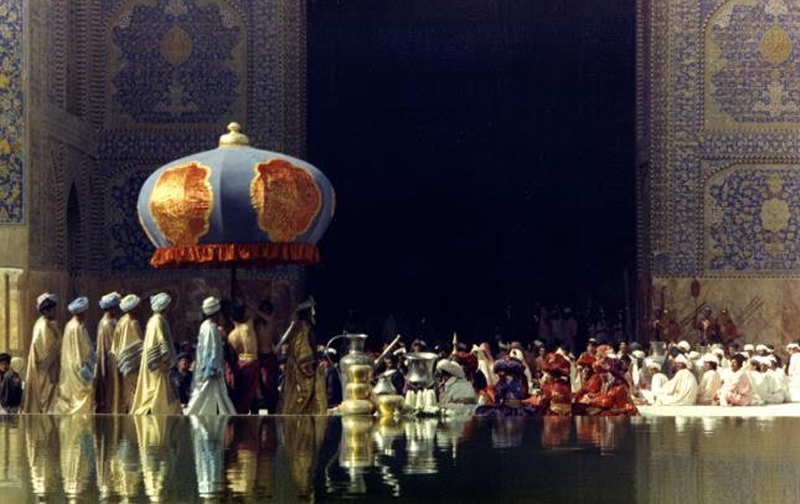
Finally, Arabian Nights (1974) took Pasolini’s visual adventurousness to non-Western locales. Filming in Yemen, Iran, Nepal, and Ethiopia, he sought to capture the exotic, storybook atmosphere of the One Thousand and One Nights. Arabian Nights is arguably the lushest and most sensuous of the trilogy, reveling in oriental fantasy. Pasolini was careful, however, not to impose Western orientalist clichés. Instead, he used many authentic local garments and crafts to shape the film’s look. As Saillard points out, for Arabian Nights Donati often “used existing clothes” sourced in the locations themselves . This was partly practical (the sheer number of extras and costumes needed in bazaar and festival scenes made local procurement wise) and partly philosophical: by using real traditional attire from Persia, Yemen, etc., Pasolini hoped to avoid a Eurocentric “Arabian Nights” pastiche. The result is a film where fabrics and costumes burst with color and variety: Yemeni merchants in striped djellabas, Persian courtiers in embroidered silk coats, dancing girls with jingling anklets and hennaed hands, and, of course, no shortage of bare skin in the film’s many erotic interludes. In fact, Arabian Nights is suffused with sensual textures – the soft swish of sheer veils, the glitter of inlaid jewelry, the warm glow of sun on bronzed skin. Its cinematography (by Giuseppe Ruzzolini) captures a veritable tapestry of hues, from the blue mosaics of Esfahan to the golden sands of the Arabian desert. One could say that Pasolini indulged in a kind of visual hedonism here, aligning with the film’s thematic celebration of love in its many forms. The narrative follows the young man Nuredin in his quest to reunite with his beloved slave-girl Zumurrud, but branches into story upon story – a structure mirroring the interlaced tales of the Nights. Each tale has its own mini world of costumes: for instance, one tragic romance is set in a fantastical version of a Chinese court, for which Donati created flowing silk robes and delicate headpieces quite distinct from the Arab garments elsewhere. Another tale involves a mischievous demon who invisibly manipulates a prince and a common girl into a sexual tryst; the prince is dressed in pristine white robes, symbolizing his purity (or naiveté), while the girl wears simple village garb – their coupling is filmed tenderly, often nude, highlighting that human desire transcends social costume. Through all these episodes, Pasolini maintains a tone of wonder and present-tense myth: we are always aware that these are ancient tales, yet he films them with an eye for the spontaneous and real. He populated scenes with real bazaars and villagers when possible, and even moments of magical realism (like a man transformed into a monkey) are handled with straightforward simplicity rather than elaborate effects.
It is worth noting Pasolini’s guiding conviction that pre-modern cultures, whether in 14th-century Florence or in some imagined “Orient,” possessed an authenticity and freedom that his own contemporary Italy was losing. By 1974, he was voicing bitter critiques of the homogenizing effect of late capitalism, which he dubbed an “anthropological mutation” destroying ancient cultures. The Trilogy of Life was, in a sense, his ode to the life-affirming erotic and communal values of the past – and the visual richness of those films is a direct expression of that affection. As Pasolini himself said, he made them “out of a belief in the progressive potential of the past” – paradoxical as that sounds. The costumes, architecture, and landscapes of the trilogy are celebratory: colorful, abundant, brimming with life, in stark contrast to the drab, conformist clothing and sterile cities of the modern world that Pasolini despised. Indeed, an exhibition of Pasolini’s work notes that even the costumes in these films function as a kind of statement of truth – “banners of truth or ‘embodied reality’,” as the curators put it . In Arabian Nights, for example, the innocence of Nuredin and Zumurrud’s love is ‘true’ because it unfolds in a world uncorrupted by modern prudery, symbolized by their carefree nudity and the frank sensuality of the surrounding culture. In Pasolini’s eyes, a medieval peasant’s rough tunic or a Bedouin’s robe was an “honest” costume, carrying an embedded reality of who those people were, whereas a modern suit and tie (or the Fascist uniform, or the business blazer) was a kind of lie, a repression of humanity. He once remarked that after the 1960s, “there are no longer any visual differences between peasants and the bourgeois” – a lament that mass-produced clothing had leveled class distinctions and regional identities . His films, especially the trilogy, lovingly restore those differences in all their vivid variety. It’s telling that Pasolini and Donati arranged for the Trilogy of Life costumes to be preserved in the Farani tailoring house archives in Rome, where they remained long unused – a “fragile legacy” of an Italy that, in some ways, never was except through Pasolini’s imagination . In recent years, those costumes have been exhibited and even modeled (notably by Tilda Swinton in the “Embodying Pasolini” performance ), revealing how modern designers from Yohji Yamamoto to Alessandro Michele have drawn inspiration from Pasolini’s visionary wardrobe . The loose, ancient-style shapes, the “decorative excess” and raw edges in Pasolini/Donati designs anticipated a certain avant-garde fashion sensibility . As Saillard quipped, in some of Margiela’s deconstructed couture you can sense that “rough edges… authority because the idea is worth more than the savoir-faire – that’s quite a Pasolini notion” .
Yet, just as Pasolini had celebrated the pre-modern life force, he soon recoiled from what he saw as its misappropriation by consumer culture. In 1975, disillusioned by how audiences seemed to receive the Trilogy of Life as mere erotic entertainment, Pasolini publicly renounced his trilogy and set out to make a film that would be a bitter antidote: Salò, o le 120 giornate di Sodoma (Salò, or the 120 Days of Sodom, 1975). This final work, released just after Pasolini’s own tragic murder, is his most controversial and visually austere film – a far cry from the exuberance of the trilogy. Salò transposes the Marquis de Sade’s tale of obscene atrocities to the last days of Mussolini’s Fascist rump state (the Republic of Salò in 1944), making it a scathing allegory of power, corruption, and degradation. Every element of Salò’s visual design is calculated to disturb and indict. The setting is largely a grand countryside villa and its walled garden, where four fascist libertines imprison and torture a group of youths. Production designer Dante Ferretti chose actual mansions around Mantua for location shoots, then modified interiors to fit Pasolini’s vision . Although the buildings were somewhat decayed, Ferretti added a surface “polish to each room” through strategic set dressings – “grandiose Art Deco light fixtures, oversized mirrors and furniture” . Thus, the villa’s rooms have an eerie elegance: high ceilings, gleaming parquet floors, luxurious chandeliers. This refined backdrop starkly contrasts with the unspeakable acts committed there. With Ferretti’s touch, Salò “takes a historied location and ups the ante by staging it with floor-to-ceiling Fernand Léger–esque murals, and art-nouveau and Bauhaus paintings” adorning the walls . The clean geometry of those modernist murals (blocks of color, abstract shapes) and the stylish 1930s decor create an atmosphere of cold, sterile beauty – a fitting environment for clinical evil. One almost senses the influence of De Chirico’s empty formalism or the metafictional sets of Brecht’s Mahagonny. The color palette is subdued: lots of black, white, gray, and a sickly pale light from shuttered windows. Tonino Delli Colli filmed Salò with a static, detached camera style; shots are often symmetrical, as if the depravity is being recorded in an official log. Indeed, Pasolini deploys distance as a tactic: the infamous final sequence of torture is mostly viewed through a pair of binoculars from afar, as if we the audience are complicit voyeurs powerless to intervene.
The costumes of Salò are deceptively impeccable. The victims – the kidnapped teenagers – for most of the film wear a uniform of simple peasant-style clothing: plain white smocks or undergarments for the girls, and military-green fatigues or black shorts for the boys. This uniformity reduces them to anonymous bodies, blank canvases for abuse. Over the course of the film, they are gradually stripped of even these modest clothes, reinforcing their abject vulnerability. By contrast, the libertines and their collaborators are dressed with immaculate formality. The four male libertines (the Duke, Bishop, Magistrate, and President – representing societal elites) spend much of the film in tailored black dinner jackets or fascist uniforms. They dine in tuxedos, calmly discussing torture over fine china – an image as grotesque as any in the film, because of the juxtaposition of civilized appearance and barbaric intent. In one chapter of the film, the libertines don women’s clothes and makeup (one wears a bridal gown) for a deranged “wedding” scene – a visualisation of perversion of roles and the mockery of innocence. The supervising guards (young fascist soldiers) wear black shirts and jackboots, the emblematic garb of 1940s fascism. Late in the film, there’s a scene where a few of these guards dance a waltz together in a lavish salon, wearing the silk dressing gowns of the libertines (the exhibition notes refer to these as “executioners’ dressing gowns” ). The gowns are elegant – one pink, one blue, one green – a chilling pastel softness draped on agents of brutality . It’s as if Pasolini momentarily costumes the fascists in the raiment of decadent courtiers, highlighting the continuity between aristocratic privilege and fascist excess. Throughout Salò, the clash between the appearance of cultivated refinement and the reality of grotesque violence is the central visual irony. As an observer quipped, Salò is “coldly violent and emotionally brutal,” yet one finds oneself drawn in by its “horrifyingly beautiful interiors” . Pasolini wants the viewer to recognize that the face of tyranny may wear a well-tailored suit or a silk gown – that perverse power often hides behind aesthetics of order and cleanliness. Indeed, Pasolini believed that the new fascism of consumerist, bourgeois society had merely “changed clothes” from the old fascism . In Salò, fascists literally change clothes in perverse games, but their essence remains vile. As one critic in The Nation summarized, Pasolini’s view was that postwar neo-capitalism had not defeated fascism but altered its costume – a thesis Salò drives home with pitiless imagery.
There is a harrowing sequence near the end of Salò that crystallizes Pasolini’s visual strategy. The libertines have moved the remaining youths to a circle of hellish punishment. We see them sitting at a distance, at the center of a courtyard, as one by one the young victims are tortured and mutilated. We watch this through the aforementioned binocular perspective from the libertines’ point of view in an upper window. The torturers below are methodical, almost ritualistic in their tasks. The victims are naked, their earlier simple costumes now entirely gone – they have been stripped of all identifiers of humanity. The setting is an enclosed “garden” of torture; significantly, this final arena is outdoors, cold and muddy, a far cry from the decadent interiors. Yet Pasolini’s camera remains deliberate and formal, almost tableau-like. The composition of each torture scene is carefully arranged (scholars have noted that some of these tableaux were inspired by classical artworks – for example, one burning victim recalls the posture of St. Sebastian, and a scalping scene evokes Goya’s grotesqueries). In the midst of this carnage, the libertines are upstairs in their genteel robes, observing through binoculars as if at an opera. One libertine even delicately applies lipstick and dons a wig to heighten his pleasure, costuming himself even at the final atrocity. The final shots show two young guards (mere boys, really) in the villa’s parlor, now removed from the violence, awkwardly slow-dancing to a radio tune. One guard asks the other for the name of his girlfriend back home; he replies “Margherita,” and the banal conversation fades as the film ends. These guards, dressed in standard Italian soldier uniforms, in this moment appear normal – just youths making small talk, swaying to music. The utter banality of evil is captured in their simple dance and simple clothes, after we’ve witnessed an hour of utter horror. Pasolini leaves us with this dissonance: the uniformed boy-next-door as executioner, humming a pop song. It is a deeply political message encoded in a quiet visual moment.
Pasolini’s murder shortly before Salò’s release cast a shadow of reality over the film’s nightmare. Many couldn’t help seeing Pasolini’s own violated body in the final images of violated youth. With Salò, Pasolini had intended to create a “last scream” of protest – against the dehumanization he perceived in modern society, against the loss of genuine sacredness. The film’s uncompromising images ensure it remains notorious and seldom “enjoyed” in the usual sense. Yet even here, Pasolini’s meticulous artistry with set, costume, and camera cannot be denied. In an ultimate irony, he composed Salò’s barbarity with the same care a painter brings to a canvas – the symmetry, the color control, the chilling elegance all serving to make the content all the more revolting. One might say he achieved a perverse kind of sacredness in Salò by portraying evil with such clarity that the viewer is forced to confront it, with no comforting distractions. In Pasolini’s own artistic journey, Salò stands as the negative image of Accattone or The Gospel According to Matthew: where the early films found grace among the damned, Salò finds damnation among the outwardly graceful.
Reflecting on Pasolini’s complete oeuvre, a remarkable consistency of vision emerges despite the diverse genres and tones. Pasolini’s cinema is ultimately a cinema of bodies and spaces, of surfaces and souls made visible. His training as a poet and painter gave him an acute sensitivity to how things signify in themselves – a torn shirt, a cobblestone street, a ray of light on a wall. He once wrote that cinema is “a language of reality,” a medium where the world’s real images (rather than abstract symbols) communicate directly . True to this belief, Pasolini filled his frames with the real textures of life: the weathered faces of non-actors, the tactile grain of coarse cloth, the dust in a peasant’s courtyard, the flicker of firelight on a cave painting. These elements often carry sacred or political weight not through heavy-handed explanation but by their very presence. A critic in Senses of Cinema noted that Pasolini’s style is often “Romanesque or frontal,” as if each shot were a tableau in a church nave, confronting the viewer directly with its symbolic import . Indeed, think of Magnani’s Mamma Roma walking toward us down a nocturnal road, street lamps receding behind her – a modern Mater Dolorosa trudging through an urban Via Crucis. Or the sight of the rag-covered Accattone, perched on a wall, gazing at the sky with the distant look of a martyr receiving a vision. Or again the figure of Jesus in Gospel, striding through a crowd of old Italian contadini who could have stepped out of a Renaissance Nativity scene. These indelible images speak in Pasolini’s “non-conventional, non-symbolic language” of cinema, which relies not on literary dialogue but on the signifying power of reality itself . As Pasolini learned working with Delli Colli, a 50mm lens could capture an actor and his environment in sharp focus together – “everything more concentrated” – and he liked that because you see the person and their world as one . In his films, clothes, backgrounds and faces all converge to express an idea or emotion. Pasolini assembled around him a “great group of artists” – cinematographers like Delli Colli, designers like Ferretti and Donati – to help implement his vision . They in turn recall him as an instinctive visual thinker. “Pasolini was something else,” Delli Colli said, remembering the young director’s reverence for the image, his “specific suggestions” and references to painting . Though not initially versed in technical cinematography, Pasolini quickly grasped its essence. By his third film he was coming to set with shot plans and even aperture settings prefigured – “he had planned everything the night before,” Delli Colli marvelled . Such meticulous preparation speaks to Pasolini’s quasi-scholarly approach to mise-en-scène: he choreographed light, color, and costume like elements of verse, each to contribute to the overall meaning.
It would be a mistake, however, to imagine Pasolini’s films as static museum pieces of art history. For all his learned references and careful compositions, there is a wild, beating heart in his cinema. He adored faces – especially those of ordinary people: the toothless grins, the fierce eyes, the weathered brows of peasants and slum-dwellers. In them he found a kind of sacred authenticity that polished actors could not convey. This is why he cast people like Franco Citti, Ninetto Davoli, or actual villagers over and over. He once described the sub-proletariat (the underclass) as Italy’s “real Christ bodies”, living embodiments of a lost sacrality. That sense comes across whenever his camera lingers on a non-actor’s face simply gazing – as when the camera surveys the peasant onlookers during Christ’s procession in Gospel According to Matthew: each face, carved by poverty, becomes a visage of timeless devotion. Pasolini’s aesthetics of poverty was not to glamorize suffering but to assert the presence of grace in the marginalized. And in parallel, his aesthetics of ritual and sensuality insisted that human physicality – sex, laughter, eating, excreting – could be as ritualistic and meaningful as any church sacrament. In Trilogy of Life, the act of love is frequently portrayed as a natural rite, free of guilt. The films are full of rituals: weddings, funerals, religious processions, seasonal festivals, strange initiations (like the test of the virgin in Arabian Nights). Each is shown with attention to the textures of ceremony: the specific garlands worn, the chants uttered, the movements prescribed. Through these, Pasolini communicates an idea of the sacred and profane colliding – the notion that in the ritual act (be it holy communion or a pagan sacrifice, be it a wedding feast or an execution) the deepest truths of a culture are revealed. Perhaps this sensibility is rooted in Pasolini’s Friulian childhood amid peasant religious festivals, or in his readings of anthropology (he was influenced by Frazer, Eliade, and others who wrote of cyclical time and “hierophanies” – eruptions of the sacred in the everyday ). Pasolini believed in cycles of death and rebirth, in the “eternal return” of nature’s seasons as a genuine sacred time, as opposed to the linear, materialist time of modernity . This is why his films so often end with a sense of completion or renewal despite tragedy: the death of Accattone leads to the dream of peace; the finale of Medea returns to the rising sun; the Trilogy of Life films all close with life going on – the painter dreaming of another work, Chaucer closing his manuscript, Nuredin and Zumurrud reunited in love. Even Salò, nihilistic as it is, ends with that banal dance – life, in its most vacuous form, still goes on. One could say Pasolini staged myth as present-tense reality throughout his work: whether adapting Sophocles or the New Testament or Boccaccio, he insisted on bringing those stories into the now, into visceral contact with the viewer’s world. He famously said he filmed the past “with the eyes of the present.” In doing so, he made viewers experience Oedipus or Christ or Chaucer’s rakes not as distant figures in books, but as immediate, flesh-and-blood presences. This immediacy was achieved by his concrete visual strategies – the gritty sandals and sweat of Gospel, the mixed-culture costumes of Oedipus, the erotic candor of Decameron.
In the end, Pasolini’s cinema leaves us with images that are sacred in their very physicality. A tattered piece of clothing, a patch of rough burlap on a peasant’s shoulder, becomes a holy relic of a world more honest and more human. His longtime designer Donati once remarked that Pasolini “was more interested in clothing’s social status than fashion” , and indeed in Pasolini’s hands a costume speaks volumes about class, power, and aspiration. Each film’s costume palette – be it the boiled wools of Gospel, the felt of Decameron, or the velvet of Canterbury – serves as an visual code, a “vocabulary in motion” to express Pasolini’s thoughts . Likewise, every landscape or set was chosen or modified to carry meaning: the slums of Rome as the stage of a modern Passion, the deserts of Morocco as the canvas of myth, the lush gardens of a palace as the cynical playground of fascist predators. As one exhibition on Pasolini observed, his costumes (and by extension, all his visual designs) function as “banners of truth” – they reveal what lies beneath society’s surfaces. If a character is cruel or foolish or saintly or lustful, Pasolini finds a way to show it in their outward appearance or immediate surroundings. This is not done through caricature but through poetic realism. He had, in the words of Delli Colli, something “intangible but very clear” in mind for each film’s look . He communicated this vision to his crew often by citing an existing artwork or a certain quality of light he wanted. And crucially, he allowed for imperfection and accident. “It’s very important to make mistakes,” Ferretti recalls Pasolini believing, “because when you make a mistake, it makes everything appear more believable. When everything is perfect, it looks too fake” . Pasolini’s willingness to embrace the rough edge – the unpolished performance, the asymmetrical composition, the dirty face, the torn fabric – is precisely what gives his films their soulful authenticity. Life is imperfect, and thus truth lives in imperfection. In a pristine studio set he felt no life; on a real location with cracks and weeds, he found truth. Even on those occasions when he built sets, Ferretti notes, Pasolini would often insist on a 360-degree construction – four walls – so that the camera and actors could roam freely and catch stray, unplanned details . That openness to the unpredictable within a carefully conceived frame is a hallmark of his style.
Pasolini’s cinematic oeuvre, spanning little more than fourteen years, forms a rich tapestry of visual storytelling that has influenced countless filmmakers, designers, and thinkers after him. His contemporaries like Bertolucci and Fellini admired his audacity (Bertolucci said Pasolini “invented a new language” ). Today, the enduring fascination with Pasolini – marked by centenary retrospectives and exhibitions of his costumes – attests to the depth of his artistry. He was a dissident who chronicled the abuses of power and a dreamer who exalted the dignity of the oppressed. And he did so not with grand speeches but with images that burn into the mind. In watching his films, one finds oneself repeatedly struck by the poetry of the concrete: the way a simple gesture or object can transcend itself. A forlorn boy tied to a bedframe under a stark light (Mamma Roma) evokes the sacrifice of a saint ; two peasants laughing under a tree (The Decameron) become timeless figures of joy; an exiled father wandering naked in volcanic wasteland (Teorema) crystallizes existential despair; a lavish chandelier glowing above an atrocity (Salò) signifies the chilling refinement of evil. These are Pasolini’s dialectics of image. Through dress, fabric, space, light, and cinematic texture, he created a sacred grammar of the visual – one that speaks of the eternal human drama between the spirit and the flesh, the exalted and the debased.
Perhaps Pasolini’s own words best capture his mission. Reflecting on his work blending realism and the sacred, Pasolini wrote: “To scandalize is a right, to be scandalized is a pleasure” – a statement which, paradoxically, has a moral urgency. He scandalized precisely to jolt his audience into sensing the sacredness he felt had been lost. In the luminous black-and-white of Accattone or the blazing palettes of Arabian Nights, Pasolini is always urging us to see – to really see – the humanity on screen, in all its pain, glory, and reality. We emerge from his films shaken, perhaps, but also strangely elevated, as if having witnessed a dark ritual or a forgotten prayer. The last shot of The Gospel According to Matthew shows Christ’s disciples looking up at an empty sky after the resurrection – a moment of loss, yet bathed in radiant light and accompanied by exultant music. It encapsulates Pasolini’s cinema: mourning the vanished sacred in the modern world while simultaneously rediscovering it in the cinematic image itself. His camera, with its tender attention to textures of cloth, skin, stone, and light, became an instrument of revelation. Through it, Pasolini indeed made everything sacred – or at least, he allowed us a glimpse of the sacred hidden in everything.