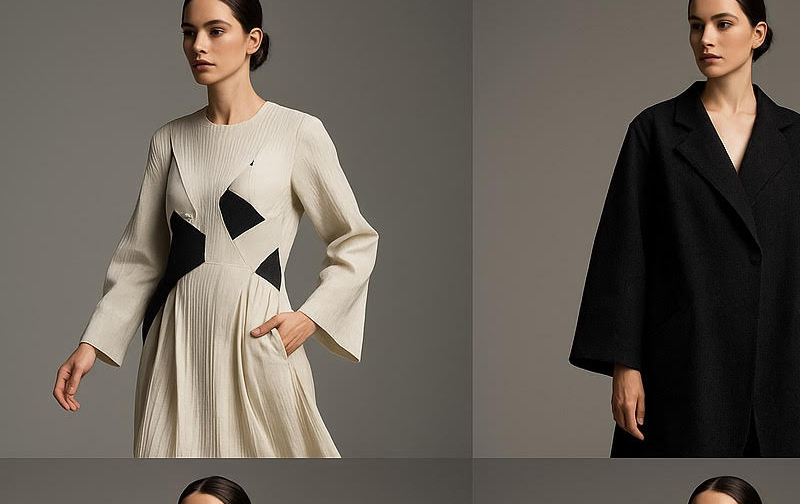
In the folds of sculptural clothing we discover a paradox: garments that read as avant-garde sculptures yet retain their humanity, gesturing toward everyday use. Clothing becomes a second skin – a space of habitual inhabitation – simultaneously armour and intimacy . This enfolding character of dress means that a dramatic, voluminous form need not alienate the body; indeed, even the most abstract silhouettes can resonate with lived experience. As theorists argue, fashion is a language of the body, with clothing’s surface signifying in a shared semiotic code. Kate Moran notes that clothing is “related to memory and personal identity” and that we communicate through what we wear by a kind of semiotic code . Roland Barthes famously taught us to read fashion as a system of signs. In a similar vein, Lucian Broscăţeanu and Oana Stan describe clothing as “like a second skin,” a habitus that we inhabit through repetition . This means each pleat or drape is both syntax and gesture – every garment a sentence written on flesh. Thus the sculptural volume of avant-garde dress is also lived surface, the fold, the loop and the loose tail carrying identity. In this sense avant-garde clothing functions as language: it speaks of subjectivity even as it abstracts the body.
Yet the academic avant-garde must remain human: each radical shape implies a wearer, each conceptual design an embodied subject. Judith Butler’s insight is germane here: identity is performative, “a set of repeated acts within a highly rigid regulatory frame” . In fashion terms, the subject has only a “limited number of costumes” from which to choose one’s gender and style . We wear our social scripts on our backs. Avant-garde designers exploit this: by breaking the rules of styling, they expose them. Rei Kawakubo’s declared goal to “break the idea of ‘clothes’” is an act of performative critique. Kawakubo’s 2014 manifesto collection Not Making Clothing exemplified this by skewering conventional garments into abstract art objects. In doing so she “puts into doubt what we take for granted, changing what clothes signify” . Her volumes and voids become gestures of resistance to normalized beauty. Similarly, Yohji Yamamoto’s draped silhouettes cloak the figure in modesty and irony. Yamamoto himself declared, “perfection is ugly… I want to see scars, failure, disorder, distortion” . Black, for him, is at once modest and arrogant – a color of autonomy . His oversized jackets and asymmetric hems evoke the Japanese aesthetic of wabi-sabi, finding beauty in imperfection and impermanence . In his 1983 Paris collection, Yamamoto famously foregrounded ma – negative space – turning emptiness into form . Black drapes slide off shoulders like silent revolution, volumes that speak without shouting. Though sculptural, these clothes breathe with the body; walked-in seams and shifting folds make even the loftiest coat feel like “everyday inhabiting.”
Eastern and Western dialectics collide in this practice. Miyake’s gentle engineering exemplifies an inclusive “democratic” avant-garde. His designs merge East and West, techno-fabric and tradition, form and utility . From the outset his credo was clothing as “a Piece of Cloth,” an ontological riff that collapses culture into craft . Miyake has explored the “fundamental relationship between the body, the cloth that covers it, and the space… created between these elements” . His iconic Pleats Please and A-POC (A Piece of Cloth) lines make utility poetic: pleated garments form living armour that moves, and knit cloth becomes an endless robe for all sizes . As his studio director notes, Miyake was “strongly motivated by… liberating the body from the constricting shapes of clothing,” creating pieces transcendending gender, age, and size . A collapsible knit, a heat-set wrinkle – technology here is a means of yielding, not control. Even in their sculpture, Miyake’s clothes are undeniably human: they question who we are without dictating it. Roland Barthes would point out that these garments function as a living sign-system, each volume and surface laying down a ‘text’ of identity and freeing the body to move.
On the Western front, Rick Owens channels brutalist architecture and survivalist myth into cloth. His “glunge” (grunge-glamour) aesthetic conflates punk’s ruin with couture’s architecture. Owens confessed that he did not set out to be “dark” so much as to reflect “the beauty and horror of the world” in equal measure . His runway gowns may float like totems; his leather jackets are jagged wings. Brutalism infuses his universe – concrete and marble appear in his furniture, and fashion critics have noted his work’s “hard, cold, rough style” built of vertical lines . Owens’ forms can feel like isolation chambers or ritualistic armor. Yet in carving these sculptural volumes he also embodies contradiction: “the dichotomy of cruelty and elegance… governed by Owens through his internal struggles” . Beneath the apocalyptic palette and distorted silhouettes lies a politics of resistance. As his stages (and Instagram) show, Owens mobilizes fashion as a critique – of consumerism, of norms – but also as catharsis. His pieces may look non-human, but they always articulate something intensely human: resilience, angst, defiance .
Throughout this discourse one must not forget the soft power of gesture. Clothing is worn, and in movement it speaks: a sleeve’s flow is a verb, a corset’s rigidity a statement. Deleuze’s concept of becoming illuminates this: identity is fluid, not fixed, and fashion is the “continuous process of creative transformations” shaping who we are . Avant-garde fashion enacts becoming by never becoming static. Clothes are not mere exteriors hiding an inner self; rather, Deleuze’s fold theory suggests identity as itself folded into garments. Anneke Smelik notes that “identity can be understood as a set of folds; folding-in and folding-out – much like the folds of the garments we wear” . In folding, the designer undoes inside/outside and invites us to do the same with notions of self. Abstraction of form does not negate subjectivity but rather remolds it. The high fashion silhouette operates like Deleuze’s “body-without-organs,” resisting any singular ideal body . In other words, the avant-garde outfit is a canvas for new subjectivities – it resists the “normative images of what a body should look like” and allows becoming-woman, becoming-nonbinary, becoming-elsewhere .
The avant-garde’s ethic is likewise subversive. It allies with critical theory’s skepticism: fashion here is not innocent fluff but an archive of power relations. Drawing on Foucault, one might say that dressing is disciplinary and liberatory all at once. Uniforms, suits, bodies sculpted by fashion – Foucault’s docile bodies come to mind – but so too does the idea that in every regime of power there is space for resistance. Clothing as “second skin” can be compliance or camouflage, but avant-garde fashion intentionally blurs that boundary. Judith Butler’s framework applies: choosing an unconventional garment is an act within a “regulatory frame” . Yet by “doing” gender differently through dress, wearers challenge that very frame. In Butler’s language, this is the subversion of gender norms: wearing an ambiguous coat or exaggerated volume becomes a form of “doing” new identity that trouble the givens . Roland Barthes might add that the mythos of fashion is overturned when a sign (like “dress”) detaches from its signifier; Kawakubo’s famous question “What’s true? The shape of this thing or the shape of fashion?” comes to mind.
Eastern philosophies slip naturally into this conversation. Zen aesthetics, Taoist voids, the Buddhist skin-off idea – avant-garde designers seem aware of Eastern conceptions of nothingness and imperfection. The Japanese notion of ma, “negative space,” was brought to the global runway by Yamamoto’s Black Collection, turning emptiness itself into a sculptural element . Wabi-sabi, the art of impermanence and incompleteness, underwrites the celebrated “flaws” in avant-garde dressing. In Zen terms, a garment is impermanent, constantly folding with breath. Thus a jacket’s fall on a model’s shoulder echoes ma: the absence is as eloquent as the cloth. This Eastern sensibility counterbalances Western deconstructive theory (Derridean deconstruction, which has long influenced post-1980s Japanese fashion) . Indeed, one might say that avant-garde fashion is the world’s own act of deconstruction: continually undoing and reassembling meaning. Gizem Kızıltunali aptly observes that “fashion, as a whole, is deconstruction” – garments are always recycling past, present and future designs, constantly distorting conventional meaning patterns . In Kawakubo’s fracturing of the garment, in Miyake’s origami-pleats that change shape with the body, in Owens’ asymmetrical draping, one sees that fashion does not finish its sentences but rewrites them forever.
Yet despite this theoretical depth, wearable avant-garde must answer practical rhythms: utility, temporality, sustainability. Miyake’s “clothes for living,” made with technical ingenuity, insist that even the radical can be useful . His pleats are daily armor – easy-care, body-liberating, transcending the fad cycle. This echoes a post-2020 consciousness that values “buy less, buy better”: avant-garde need not mean one-off couture. Instead it can mean clothing that lasts and changes meaning over time. Temporality is thus part of the manifestos: garments are archives. Comme des Garçons shows archive looks; Yamamoto works like brushes on canvas each season. As Lucian Broscăţeanu notes of Kawakubo, each collection is a “story about various aspects of the social environment,” an emotional archive of our age . In this way clothes become an “external memory” of resistance – an embodied record of ideas.
In sum, the wearable avant-garde draws from East and West, philosophy and materiality, to forge an ethic of clothing as lived art. Sculptural silhouettes can remain human and everyday when they engage subjectivity, gesture and context. They carry signifiers of identity even as they break with tradition. They perform as armor and second skin, as archive and statement. The designer’s task is as much theoretical as aesthetic: to create volumes and gestures that provoke thought and communicate socially. As Gill Sevcenko and others have argued, fashioning this way can be an act of “subversion” and of care – offering new forms of embodiment that resist oppression . A post-2020 wearable avant-garde recognizes fashion’s power – as deconstruction, as critique, as poetry – without losing touch with the “people who wear it”. By weaving in critical theory, phenomenology, and social consciousness, it becomes a manifesto in cloth. Wearable avant-garde thus stands as a philosophical practice: a dressing of the world with ideas, giving form to resistance, utility, and identity in every pleat and pocket.