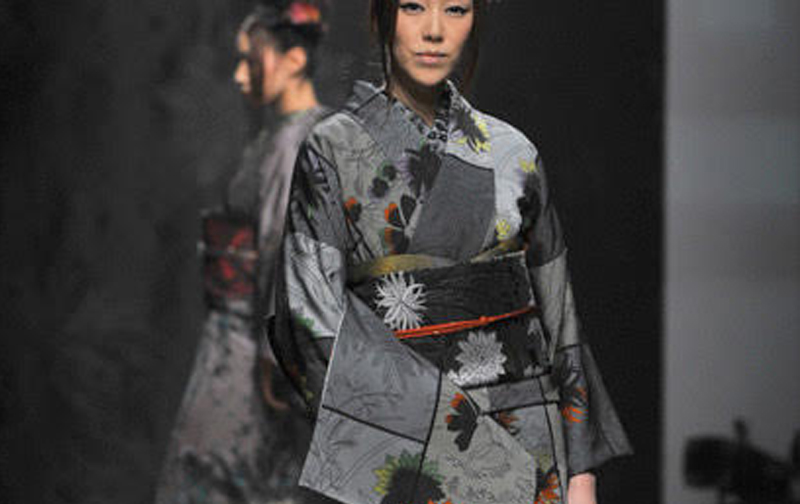
The kimono is far more than a robe; it is Japan’s traditional garment and a potent cultural symbol. Literally meaning “thing to wear,” the kimono’s basic Y-shaped form – a simple rectangular cut with a left‐over‐right wrap – dates back over a millennium . For centuries the kimono was everyday dress in Japan, its layered colors and patterns signaling season, rank and occasion . In the Edo period (1603–1868) an entire fashion culture emerged: kimonos were woven of silk and dyed with natural scenes – peonies, chrysanthemums, cranes (symbols of eternal love), fans and carriages referencing The Tale of Genji and Noh plays – so that one’s identity and aesthetic sensibility were literally dressed on the body . By the late 19th century, however, the Meiji Restoration ushered in Western styles: the Emperor and courtiers took on European uniforms, and by World War II Western clothing had all but supplanted daily kimono use . Even the Meiji government at times actively discouraged kimono for modernity. Today, kimonos survive mainly for ritual and ceremony: at New Year’s shrine visits, tea ceremonies, weddings and graduations a kimono’s timeless form lends “gracious formality” to the occasion.
Historically the kimono itself was a hybrid. Early Japanese court dress came from Chinese Hanfu in the 7th–8th centuries, and over Heian court culture (794–1185) uniquely Japanese “kokufū” styles developed . The stiff, multilayered Heian jūnihitoe for women (sometimes twelve robes deep) eventually gave way to the simpler kosode that would become the ancestor of the kimono. Intriguingly, even during Japan’s isolationist Edo era the fabric trade was international: Dutch traders imported Chinese silks, French brocades and Indian calicos, all of which were turned into kimono textiles . In other words, the kimono’s silhouette remained constant even as its materials and decorations absorbed global influences. This is part of what curator Anna Jackson notes: “the shape of the kimono has remained virtually the same for four centuries, but the surface details have changed dramatically” . Over this period the kimono also accrued layers of meaning. In medieval and Edo Japan, strict sumptuary laws governed who could wear what colors and patterns; a samurai’s kimono, a geisha’s outfit and a peasant’s everyday robe all communicated social hierarchy. Thus the garment was always political as well as aesthetic. In the early 20th century, nationalists pushed the kimono as Japan’s national dress – so much so that by the 1930s patriotic propaganda adorned kimonos with tanks, flags and soldiers in flight – before the tidal wave of postwar Westernization made the kimono rare in daily life.
Anthropologists and cultural theorists emphasize how deeply the kimono is woven into notions of identity and tradition. Scholar Amanda Stinchecum notes that Japan has “maintained a single tradition in clothing over many centuries” – the kimono is the modern descendant of that legacy . Legend has it that wearing kimono wraps one not only in fabric but in cultural memory. Researcher Josephine Rout writes that wearing a kimono means “not merely dressing; the materiality of the kimono leads one into a specific embodiment of Japanese culture…deeply connected to the history of Japan and one’s own perception of his/her silhouette.” In other words, to don a kimono is to “wrap oneself in an exotic beauty” distinct from Western fashion . The late designer Itoh Motoshige captured this when he said: “If the kimono were to disappear, society would lose its gracious gloss” . Such statements reveal how the kimono has been mythologized as a vessel of Japaneseness. Even Roland Barthes once classified kimono as a garment whose unchanging shape puts all emphasis on surface design, creating an “eternal style” – an idea echoed in today’s scholarship that kimonos lend their wearers “timeless, gracious formality” . Yet other analysts remind us that what seems ‘ancient’ is often consciously maintained. The anthropologist Eric Hobsbawm’s concept of “invented tradition” has been applied to modern kimono culture: the Meiji-era push to define a single national dress can be seen as a ritualized linkage to a constructed past . In short, kimonos carry a “double otherness”: they are both museum-like symbols of an immutable heritage and dynamic canvases for contemporary creativity.
Today the global life of the kimono is marked by intense cultural and economic tension. In Japan the garment’s market and wearing have collapsed. Lucrative production worth $16 billion in 1982 fell to about $2.5 billion by 2015 , and domestic output plummeted from roughly 16.5 million pieces in 1966 to only about 40,000 in 2016 – a 97% collapse. Consumer spending on kimonos dropped 82% from 2006 to 2020 . Now kimono wearers in Japan are a small minority (mostly women in their 50s–70s) who wear them only for ceremonies . Japanese press and scholars note that the kimono shifted “from hegemony to rarity” in a single generation . Against this decline, various parts of Japanese society have scrambled to reclaim or repackage the kimono. The national government even formed a “National Dress Preservation Association” to study how to revive kimono culture . Traditional kimono schools (kitsuke) teach etiquette, but new designers experiment: they market shorter, open-collar kimono jackets, use synthetic fabrics and novel prints, or combine kimono elements with Western cuts . Many young Japanese now treat kimono as a fashion statement or a tourist experience – renting one for Instagram shots rather than inheriting ancestral silk.
Indeed, commodification of kimono has become globalized. In tourist cities like Kyoto one sees foreigners trudging through temple precincts in rented kimonos, selfie sticks in hand . As researcher Lucile Druet observes, in the Meiji era the kimono was already commodified as “the Japanese national dress, symbolizing Japan as a land full of exquisite, exotic traditions”; today that image still thrives even as production wanes . The kimono is marketed as part of Japan’s soft power: cultural exhibitions from Paris to Tokyo display Edo to runway kimonos , and organizations lobby UNESCO to list the kimono as intangible cultural heritage . Child‐education projects in Kyoto even bring Nishijin silk weavers and Kyō-yūzen dyers into schools to “contact tradition from childhood” . In these ways Japan tries to keep the kimono narrative alive. But on the streets and online, the kimono is also just another fashion object. Rental shops and fashion tourism pitch the kimono as an “authentic” Japan experience . To the casual observer it can appear no different than a costume or dress-up: one sociologist notes that many tourists treat kimono “as something approachable, cheap, fun, and playful, as cosplay”.
Meanwhile the West’s relationship to the kimono raises questions of appropriation and global culture. The kimono has long attracted the Occidental gaze. In 1876 Claude Monet painted his wife dressed in a crimson kimono, La Japonaise, an iconic example of Japonisme and Orientalism . The West often eroticized the “kimono-clad” woman as emblematic of exotic Japan. Pop culture has continued this trend: Western brands and celebrities have repeatedly drawn on kimono imagery (Gilbert & Sullivan’s The Mikado, “Geisha” stage costumes, Lady Gaga in kimono-inspired garb). Recently, controversies erupted: when Kim Kardashian West announced a shapewear line named “Kimono,” she was sharply rebuked by Japan’s mayor and others as ignorant of history . Critics pointed out that during WWII, owning a kimono in America was once banned under anti-Japanese sentiment, so using the name for lingerie was especially charged . Kardashian ultimately apologized and rebranded, after #KimOhNo trended and Kyoto officials protested .
But beyond headlines, the general issue is whether Western adoption of the kimono is cultural theft or cultural exchange. Major fashion houses have long quoted kimono shapes. Dior and Galliano cited Japanese robes in couture, Alexander McQueen gave Björk a kimono on an album cover, and in the 2000s designers like Marc Jacobs, Donatella Versace and others reworked kimono-inspired prints or cuts. Some commentators call these homages “cultural appreciation,” while others decry them as appropriation – especially when the garments carry no tag acknowledging their heritage. Indeed, a 2018 Boston museum event (“Kimono Wednesdays”) where visitors tried on a kimono for a Monet exhibit sparked protests. Activists accused the program of “racist, Orientalist appropriation,” while defenders called it respectful cultural sharing . Scholars like Michelle Carriger have argued that debate often slides into binary arguments that miss nuance: Japanese voices often see kimono interest as flattering, whereas diasporic Asian-Americans might emphasize historical wounds.
One lesson is that what “counts” as a kimono is itself contested. Across Instagram and Zara stores one now finds “kimono” jackets – short draped cardigans with printed patterns – that resemble the Japanese kimono only vaguely . As Densho blogger Emi Ito notes, countless jackets, sweaters and even jumpsuits are labeled “kimono” by fast fashion brands , yet bear little resemblance to the real thing. Such misuses, she argues, erase the kimono’s significance: true kimonos in her family were sacred heirlooms passed through generations, “folded and tucked around” mothers and grandmothers for weddings and festivals . To wear an actual kimono, Ito says, is to wear your ancestors and your cultural history. Thus when a Western teenager dons a “kimono” from Amazon for fashion, some Japanese critics see it as cultural dilution. Others say that cross‐cultural borrowing is inevitable in fashion; after all, Japan itself borrowed heavily. (As Vogue points out, Edo Japanese kimono makers used imported French brocade and Indian calico.)
What of Iran? Surprisingly, parallels emerge. Like Japan, Persia (Iran) has an ancient sartorial heritage and complex gender codes. Persian women’s clothing long emphasized modesty and layers: for centuries many Iranian women wore a chador, a semicircular black cloth wrapped around the head and body , much as kimono layers cover most of the body. The Safavid dynasty (16th–17th century) made Islam state religion, spreading the practice of covering women’s hair and form as a unifying cultural symbol . After the 1979 revolution, Iran made hijab mandatory for all women, the headscarf and robe becoming symbols of national piety and identity . In both Iran and Japan, public morality has been read through dress. Iranian law still forbids “sensual” clothing in mixed company ; similarly, for much of modern history the kimono was expected to cover men and women “modestly” – sleeves long, collars high – so as not to entice. The concept of covering hair in Iran (as required) parallels the idea in Japan’s past of covering certain body parts; both traditions hold that garments contain and guide femininity.
Aesthetically, Iranian and Japanese garments share love of pattern and craftsmanship. Persian textiles – carpets, brocades and embroidered silks – are renowned, just as Nishijin brocade and Yuzen-dyed silk are in Japan. Traditional Persian women’s outfits often featured a long shirt (pirahan) and layered robes. The zīrī-qāba (an under-robe) and rūyī-qāba (outer robe) were richly embroidered , sometimes with sashes or belts (“kamarband”) at the waist, much like the obi belt on a kimono. Iranian men wore the qaba or jubba – long flowing coats with wide sleeves – quite similar in cut to a men’s kimono and obi. In fact, a modern Persian garment seller notes that the qaba was “a long, flowing coat often worn over a tunic, with wide sleeves and intricate embroidery along the edges” , worn by nobles and religious scholars as a symbol of status. This resembles how silk kimonos once marked the wearers’ rank.
Where ritual is concerned, both cultures treat certain garments as sacrosanct. Kimonos are worn at Shinto rites (weddings, coming-of-age), just as chadors and festive coats are worn at Muslim ceremonies. In Iran, religious pilgrimage to shrines often involves women wearing the black chador in solemn devotion – not unlike a Japanese woman wearing a black tomesode kimono to a funeral. And on Persian New Year (Nowruz) or weddings, Iranian brides often don new, often white, embroidered dresses; in Japan a bride may similarly wear a pure white shiromuku kimono. In both cases, traditional dress on special days is a way of enacting communal memory and hope.
Yet despite these parallels, the meanings diverge. The kimono is often celebrated in Japan as a peaceful, even “feminine” art – the serene image of a kimono-clad figure tea-master at a pond is iconic. Iranian garments, especially since the revolution, have become politically charged. The mandating of the chador was in part a reaction against Western cultural influence; in Japan there was once similarly a reaction (postwar nationalism) to “Westernization,” but today the kimono is not state-mandated attire. Instead, it is marketed abroad as uniquely Japanese – Japan’s tourism ministry and fashion institutes literally export kimono imagery to promote culture. By contrast, Iran’s dress code (the hijab) is often imported into Iranian diplomacy as a signal of Islamic Republic values.
Both nations also participate in global capitalism through these garments. Japan’s kimono industry has felt competition from global textiles; expensive silk kimono are now niche or tourist goods, while Japan imports cheaper fabrics and ready-to-wear. Iran’s once-thriving textile trade (Persian silks and brocades were world-famous) has been battered by sanctions and global market forces, though Iranian designers now try to create “modest fashion” lines for international consumers. Thus, under capitalism the kimono and the chador alike circulate between tradition and trend. Factories in China or Europe churn out “kimono-style” robes that blend elements from many cultures – just as Turkish or South Asian factories now produce mass-market chadors and abayas that borrow loosely from Iranian shapes. In both cases, these items can be sold as “authentic” while their cheap manufacture divorces them from local craftsmanship.
The kimono’s soft-power diplomacy is clear: it remains a symbol Japan “boasts to the world” . High-profile exhibits (at the V&A, Tokyo National Museum, San Francisco’s Asian Art Museum) trace kimono’s story from Kyoto workshops to Paris runways . These shows emphasize how an Edo pattern looks modern on a catwalk. Japan’s trade and cultural ministries routinely invoke the kimono when discussing cultural diplomacy. For example, in 2019 Kyoto’s mayor defended the kimono by saying seeing foreigners wearing it proved “kimono… is loved by people from around the world” . In short, the kimono is a deliberate national brand. Iran too uses textiles in soft power – Persian carpets and calligraphy go hand-in-hand with chadors on state visits – but the kimono’s global cachet is more benignly “cultural” whereas Iran’s dress codes often carry a political edge.
Philosophically, the kimono poses classic questions of authenticity versus imitation. When does a “kimono-inspired” dress cease to be a kimono? Some argue that a kimono only truly “lives” when sewn and worn within Japan’s tradition of dyeing, weaving and etiquette. Others claim garments evolve; as Rout says, fashion in Japan happens more in surface decoration than in shape . A kimono motif on a sundress may strip context, but it also spreads awareness of Japanese aesthetics. Critics counter that ignoring kimono’s social origins – its familial and spiritual roles – turns it into a mere “costume.” The view depends on philosophy: is culture an immutable essence that foreigners must not touch? Or is it a shared human tapestry that freely mixes? Some theorists propose “inappropriation” – a middle path of conscious borrowing that neither fetishizes nor dismisses origins .
Sociologically, the kimono’s journey reflects Japan’s class and age shifts. Once ubiquitous, kimono became the uniform of the samurai or geisha classes; now it is the sign of an older generation or a travel excursion. The “kitsuke” schools that teach kimono dressing underscore how wearing one properly is ritualized, like a tea ceremony. In that sense the kimono is like a lived tradition – a repeated act linking wearer to ancestors . The tension between that tradition and the kimono worn as a disposable fashion item is acute. Japanese magazines now churn out “modern kimono” spreads: women lounging in casual cotton kimono with sneakers, which would scandalize an elder who thinks kimono must be formal or sentimental. Likewise in Iran debates swirl over young women wearing “colorful hijab styles” with jeans – a different instance of the authenticity-versus-trend negotiation.
Economically, the kimono has been swept into globalization. Big brands and fast-fashion chains have at times appropriated kimono silhouettes for profit (for example, retailers selling “kimono cardigans”). Some Western commentators have condemned such moves as disrespectful to Japanese heritage . On the other hand, these garments introduce basic kimono design to a new audience. There is also a luxury market niche: rare vintage kimonos and high art pieces (hand-painted kimonos, antique brocades) now fetch high prices at international auctions and boutiques. Thus the kimono sits between extremes – a status symbol in one context, an everyday shrug or robe in another.
In Iranian culture, dress similarly straddles identities and economies. Traditional Persian embroidery and silkwork resonate with Japanese brocades and silks; both countries’ museums display these textiles as art. Both cultures also offer wedding heirlooms: a Japanese family kimono or obi passed to a daughter is a treasured “family register,” akin to how Iranian families treasure bridal coins, veils, or carpets. Yet the Iranian economy of clothing today is different: Islamic modest fashion has become a growing industry, with designers selling “stylish hijabs” and abayas globally. Social media shows Iranian women creatively mixing color and form within the boundaries of modesty. In a way, Iran’s evolving dress codes are in dialogue with Japanese modesty and style: both negotiate Islamic or traditional morality with modern self-expression.
In sum, the kimono’s global life is a tapestry of continuities and ruptures. It remains a living tradition for some – for example, a Japanese mother weaving a wedding kimono or an Iranian woman hand-embroidering a chador – while for others it is a recycled motif or an orientation-lens. The garment’s very existence asks us to compare cultures: how do Japan and Iran each use clothing to shape identity? Both link fabric to morality and both have seen outsiders reinterpret their garments – in Japan’s case as fashion, in Iran’s as political symbol or religious sign. The East–West tension plays out differently in each: Japan often export-culturally cultivates the kimono’s mystique, whereas Iran sometimes view dress in more binary terms of purity vs. corruption.
Ultimately, the kimono underscores that dress is culture made manifest. Philosophers of fashion note that garments carry “inscribed messages” about who we are. A kimono is at once item and idea: a textile woven with dye and thread, and a sign system layered with generations of meaning . The debates over its wear – from haute couture runways to Halloween costume parties – are debates about the relations of power, respect and identity in our interconnected world. Its story from Japanese court to international runway, from hand-me-down to theme-party prop, reflects the push and pull of tradition and capitalism, the local and the global. In the final analysis, the kimono’s global life reminds us that even the simplest thing to wear can carry a world of history and contested meanings.