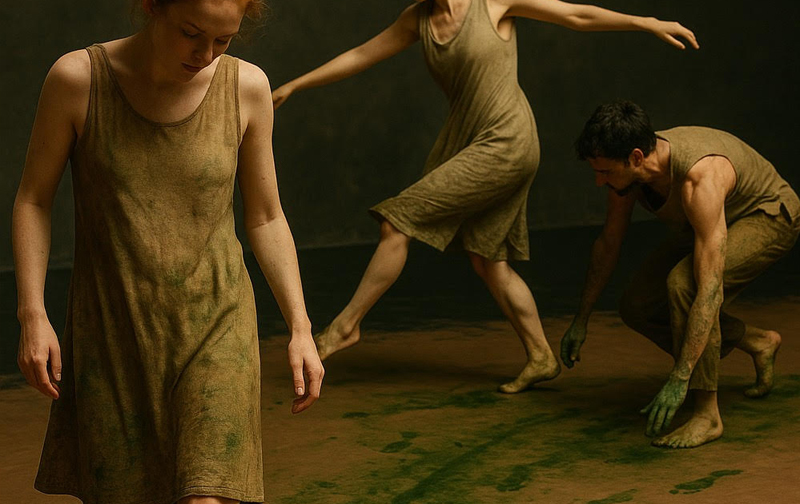
The role of costume in performance is undergoing a profound re-evaluation. Rather than seeing costumes as inert adornments or mere visual aids for character, contemporary scholarship increasingly treats them as vital agents in the theatrical event. The article “Thinking with Costume and Material: A Critical Approach to (New) Costume Ecologies” by S. Pantouvaki et al. (2021) exemplifies this “material turn” in costume studies, arguing that costumes possess an active material agency that participates in meaning-making. This perspective aligns with emerging currents in philosophy—especially new materialism and actor–network theory—which challenge anthropocentric assumptions and recognize the capacity of objects and materials to act, influence, and co-create alongside humans. In the realm of performance, this means reimagining costumes not as passive props but as co-performers that shape the dynamics of the stage, the narrative, and even the performers themselves.
Costume Agency and the “Material Turn”: In recent years, performance theorists and practitioners have begun to acknowledge what costume designers have long intuitively known: the costume “does” something in performance beyond simply looking attractive or period-accurate. Costumes can affect actors’ movements, evoke visceral responses, and even carry conceptual or symbolic weight independently of the actor’s intentions. Donatella Barbieri and Sofia Pantouvaki observe that costume is a tool to “think through, as well as to act or do, and even to be as a researcher”. Such statements underscore that costumes operate on multiple levels at once—practical, aesthetic, psychological, and theoretical. Pantouvaki and colleagues note that interest is rising in “costume’s material agency in contemporary costume research”, a previously under-researched area.
In other words, scholars are now examining how the materiality of costume (its fabrics, textures, weight, etc.) plays an active role in performance, not just how costume serves as a signifier of character or social status. Indeed, costume can be seen as a “theoretical and practical system” with “multi-level agency”, offering new ways to understand power, knowledge, and representation in performance. This marks a clear shift from older approaches that treated costume primarily as a subordinate element of scenography or as a static representation of a character’s identity. We have entered a phase where material agency – the idea that materials have their own efficacy and vitality – is being taken seriously in the context of theatre and performance design.
To appreciate why this shift is so significant, consider how costumes were typically viewed in the past. Traditionally, costumes have been understood in semiotic terms: a costume “signifies” something about a character (for example, a king’s robe signifies royalty, a tattered coat signifies poverty). Under this paradigm, the costume’s value lay in what it represented or communicated to the audience about the human wearer. The material of the costume (silk vs. burlap, for instance) was chosen to support that representation, but the material itself was not seen as having any agency or meaning beyond the human narrative. As one scholar notes, historically “the material aspects of costume” were treated as “a material object performing a signifier function for human representation”. Costume was, in effect, a passive container of meaning determined entirely by human designers, directors, and actors.
The “material turn” disrupts this one-way hierarchy by proposing that costumes and their materials have a say in performance. Sofia Pantouvaki and collaborators articulate it nicely: they aim to shift thinking “from thinking of and through materials to thinking with materials”. To “think with” costume material implies a partnership between human and non-human participants in the creative process. It means acknowledging that when a performer dons a costume, there is an encounter between the human body and the material garment, each affecting the other. The costume can shape the performer’s posture, dictate the types of movements possible, create sounds (the rustle of fabric, the jingle of beads) that contribute to the performance’s aural landscape, and even provoke emotional or imaginative responses in both wearer and audience.
Costume designer and scholar Alison Matthews David succinctly put it: “costume is never neutral; it presses on the body and psyche of the performer, eliciting responses and creative choices.” (This echoes what many actors report – that a costume can “tell” them how to carry themselves or can trigger feelings that inform their portrayal of a character.) In sum, the material turn invites us to see costumes as actants – to borrow a term from Bruno Latour’s actor–network theory – rather than inert objects. Actor–Network Theory: Non-Human Actants on Stage. Actor–network theory (ANT), developed by Bruno Latour, Michel Callon, John Law, and others in science and technology studies, famously asserts that not only humans but also non-humans (“objects, artifacts, things”) participate in actions and social networks.
7-Latour provocatively claimed that we must recognize objects as actors too, insofar as they “modify a state of affairs by making a difference”. An actor (or “actant” in ANT terms) is anything that has efficacy, that shapes outcomes by its presence and properties.
Applying this to theatre, we can say that a costume which makes a performer move slowly (perhaps because it is heavy or restrictive) is not just a decorative element – it is actively determining the choreography and rhythm of the performance. Latour gives examples from daily life, such as how a heavy hotel key fob “reminds” guests to return their keys, or how a speed bump “tells” drivers to slow down; in each case, the object exerts influence.
Similarly, on stage, a costume might “authorize, allow, afford, encourage, permit, suggest, influence, block, render possible, [or] forbid” certain actions. A stiletto heel shoe, for instance, affords a very different gait and attitude than a pair of sneakers – it might encourage a strut and simultaneously forbid quick running. A flowing cape in a costume can authorize dramatic, sweeping gestures but might block intimate close-quarter movements. ANT simply asks us to follow the chain of influences without prematurely assigning all causality to human intention. In a sense, it urges theatre-makers and scholars to listen to the material voices on the stage.
From an ANT perspective, the entire performance can be seen as a network or assemblage of human and non-human actors: the performers, the costumes, the set pieces, the lighting instruments, even the stage floor, all in interplay. Latour argues that ignoring the contribution of non-humans gives us an incomplete picture of any social (or in this case, artistic) event. If a theatrical performance succeeds in moving an audience, it’s not solely due to the human actors’ skills; the textures of the costumes, the atmospherics created by sets and lighting, the sound of fabrics, and other material elements all participate in creating the effect. Thus, taking ANT on board, we can say a costume in performance is an actant that mediates and transforms the actions of the wearer and the reception by the audience. The material turn in costume studies, influenced by such thinking, insists that we consider who and what participates in the action on stage, even if that means including “elements we would call non-humans”.
New Materialism and “Vibrant” Matter: Parallel to ANT, the philosophy of new materialism has provided powerful language and concepts for describing the agency of material things. Thinkers like Jane Bennett, Karen Barad, and Rosi Braidotti challenge the old Cartesian split between inert matter and active mind, proposing instead that matter has vitality and agency of its own. Jane Bennett’s influential book Vibrant Matter (2010) speaks of the “thing-power” of objects – “the strange ability of ordinary, man-made items to exceed their status as objects and to manifest traces of independence or aliveness”
Bennett explicitly defines vital materiality as “the capacity of things… to act as quasi agents or forces with trajectories, propensities, or tendencies of their own”. In other words, things (whether natural or artificial) are not just passive stuff; they have energetic and directional tendencies – they push back, they spark reactions, they participate in events. In the theatre context, a costume might thus be seen as having trajectories and tendencies: e.g., a large skirt tends to swing and sway with momentum, generating a certain rhythm; a latex costume tends to squeak and reflect light, adding sonic and visual dimensions unexpected by the actor.
Crucially, Bennett also reminds us that “we are vital materiality and we are surrounded by it”. The human body itself is material and continuously interacts with the materials around it. On stage, the performer’s body and the costume form an assemblage – a term Bennett uses (drawing from Deleuze and Guattari) to describe ad-hoc groupings of diverse elements that temporarily work together. In one moment, the assemblage of actor+costume might produce a graceful image; in the next, as the actor sweats and the costume sticks to their skin, the assemblage produces a sense of struggle or tension. Bennett’s philosophy legitimizes talking about the agency of costumes without mystification: it’s not that a costume has a soul or consciousness, but it possesses a material vitality that can activate and affect human actors and audiences.
Karen Barad, another key figure in new materialist thought, offers the concept of agential realism, which likewise blurs the line between matter and meaning. Barad argues that “matter comes to matter” through dynamic processes – that is, matter is not a static essence but is continually formed and reformed in relationship with the world. She writes that “matter and meaning are not separate elements” but co-constitutive, and describes materiality as “a congealing of agency” This beautifully suggests that what we experience as “material” (like a piece of cloth) is actually the temporary result of various agencies (molecular, social, historical) coming together. In a theatre costume, for example, the fabric’s drape is a congealing of physical forces (gravity, the stiffness or flexibility of fibers) and human choices (the cut and stitching by the costume maker), all of which then intra-act (to use Barad’s term) with the performer’s moving body.
Barad’s work, especially her concept of intra-action (as opposed to interaction), emphasizes that elements (human and non-human) do not precede their relational entanglement; rather, they emerge through their entanglements. On stage, the identity of an actor’s character and the identity of the costume are not fully formed independently – they emerge through the performance as the actor and costume interact intimately. This perspective supports Pantouvaki et al.’s idea that “the material, the natural and the cultural are not separate but co-constitutive”. A costume carries cultural meaning (design, symbolism), but it is simultaneously a physical material object with its own natural (or synthetic) properties, and these aspects work together to produce what we experience in performance.
Pantouvaki’s article directly engages with these philosophies. The authors invoke Elizabeth Grosz’s notion of extramaterialism, which calls for an understanding of the incorporeal conditions within materiality – essentially the idea that ideality (concept, meaning) inheres in matter itself. Grosz describes “extramaterialism” as “the inherence of ideality, conceptuality, meaning or orientation that persists in relation to and within materiality as its immaterial or incorporeal conditions”. This is a complex way of saying that every material thing also has an immaterial aspect (ideas, values, significations) that is not pasted on from outside but grows from its material existence. Applying this to costume: a costume is not just cloth (material) plus some symbolic meaning (concept); rather, the meaning arises from the material configurations.
The sparkle of a sequin, the roughness of burlap, or the flowing quality of silk – each of these material characteristics will give rise to different ideas or affects in performance. Grosz’s view helps collapse the hierarchy that puts “meaning” above “matter”; instead, it posits their equity, saying “neither is subordinate to the other”. Pantouvaki et al. take this to heart, arguing explicitly “for the equity of the material and the conceptual” in costume design and research. In practice, this means a costume designer or scholar should pay as much attention to the tactile, sensuous, physical features of a costume as to its narrative or symbolic role; the two are inextricably linked.
The material turn in costume is fortified by a chorus of voices from various fields that all seem to converge on a single insight: things have power. This idea is not entirely new – anthropologists and artists have long recognized the deep significance of material culture – but it is now being systematized in theory and given new urgency by global concerns (such as environmental sustainability, which we will discuss shortly). Let’s sample a few quotations from great thinkers around the world to contextualize this shift; French poet Charles Baudelaire wrote of fashion and fabrics with uncanny foresight. He remarked that “fabrics speak a silent language”, implying that cloth communicates meaning and emotion without words.
In the context of costume, Baudelaire’s poetic observation rings true: the texture and movement of fabric on stage can convey subtext and atmosphere in a way dialogue sometimes cannot. As an extension of this, a contemporary art writer expands: “Though it has no voice, cloth speaks in complex, multi-sensorial fashions.”. Here the suggestion is that through its visual patterns, tactile impression, even smell and sound, cloth (and by extension a costume) can deliver a message or affect that is understood intuitively by the audience. A billowing white gown might “speak” of ethereality and ghostliness; a stiff military uniform might “speak” of authority and rigidity. Importantly, this language of fabric is nonverbal and embodied – it works on the level of sensation and shared cultural understanding.
19-One of the pioneers of modern theatre theory, Antonin Artaud, had profound insights into the power of the non-human elements of theatre. Enthralled by Balinese dance performances he witnessed in Paris in the 1930s, Artaud wrote that “masks, costumes, gestures, and dances of the Balinese performers overcome their materiality and reunite us with the concept of pure theatre. They are ‘metaphysicians of natural chaos […] before which we see ourselves as ghosts.’”. In Artaud’s ecstatic account, the costumes and masks of Balinese theatre were not just decorative ethnographic curiosities; they had a spiritual and metaphysical force that Western theatre had lost. These material elements, he felt, could channel emotions and states of being more directly than speech – they “overcome their materiality” in the sense that they are not perceived as just cloth or wood, but as conduits of some larger reality.
When he calls them “metaphysicians of natural chaos,” he attributes to costumes and masks a kind of wisdom or agency: they organize the raw energies of life (chaos) into theatrical metaphors that humans can experience viscerally. Artaud’s poetic language might be extreme, but it foresees today’s idea that costumes are active participants in creating meaning, even to the point of deeply affecting the audience’s psyche (seeing ourselves “as ghosts,” as he says, confronted by the primal power of the material performance).
From a sociological standpoint, Erving Goffman famously used theatrical metaphors to describe everyday life. In The Presentation of Self in Everyday Life (1959), he speaks of the “front” every person puts on in social situations, which includes appearance such as clothing, along with manners.
Goffman notes that “the front” is comprised of both setting and personal front – appearance and behavior that signal status, mood, and intention . An illuminating line that Goffman quotes (from sociologist Robert E. Park) is: “It is probably no mere historical accident that the word person, in its first meaning, is a mask. It is rather a recognition of the fact that everyone is always and everywhere, more or less consciously, playing a role… In a sense, and in so far as this mask represents the conception we have formed of ourselves… this mask is our truer self, the self we would like to be.”. Here, “mask” can be extended to mean any outward costume or persona. The striking idea is that the mask (costume/persona) is our truer self – meaning that by adopting attire and roles, people actually become who they aspire or are expected to be.
In social life, we quite literally “dress for the part,” and the dress (suit, uniform, casual wear, cultural attire, etc.) helps to define the situation and even shapes one’s behavior and self-conception. This is a sociological confirmation that clothing has agency: wearing a lab coat, a person may feel and act more professional or scientific; wearing a policeman’s uniform confers authority not just in others’ eyes but in the wearer’s demeanor. Psychologists have coined the term “enclothed cognition” for this phenomenon, demonstrating in experiments that subjects perform tasks differently depending on what they wear (for example, people did better on attention tasks when wearing a white coat they believed was a doctor’s coat).
What all this suggests is that there is a performative power in costume – in everyday life as on stage, the material outfit is not neutral; it can transform identity and behavior. As Goffman would say, we perform ourselves and costume is a key part of that performance. Anthropologists have long studied the role of costume and dress in ritual and cultural expression, often finding that garments are treated as having life or spirit. A vivid example comes from the Yorùbá tradition of Egúngún masquerades in West Africa (notably Nigeria and Benin). In an Egungun ritual, performers wear elaborate layered costumes with veiled faces to represent returning ancestor spirits. According to the National Museum of African Art, the person donning the Egungun costume “would have transformed into a ‘returned Yorùbá ancestor’ who connected the living world with the spiritual world.”
In other words, the costume is not “clothing” at all, but a vehicle of spiritual presence. The Yorùbá term egúngún itself means “powers concealed”, indicating that the costume conceals a human but reveals a spiritual power. The layers of cloth, often donated by family members over years, carry collective memory and honor the lineage; the motion of the costume (spinning, as the masquerader dances) is believed to activate the ancestor’s blessings or judgments for the community. Here, the material costume is in a very real sense an agent of divine or ancestral agency. It is not the individual performer who is believed to be speaking or dancing, but the ancestor through the costume. The material thus serves as an embodied mediator between worlds.
Such examples underscore that in many cultural contexts, it’s perfectly natural to regard costumes as having an efficacy independent of the wearer’s individual personality. This perspective resonates with the new materialist idea of “more-than-human” agency – the notion that agency is not exclusive to humans, and that things, animals, spirits, etc., can all be part of an active network. For the Yorùbá, an ancestor’s spirit becomes present in the swirling fabrics of the masquerade; one might say the costume “performs” the ancestor.
In Iran and Ta’zieh Those characters about to attain martyrdom are dressed in pure white (a symbol of their impending death and purity of sacrifice), and any female characters (portrayed by male actors, given cultural norms) wear black robes. These costumes do not aim for historical realism; as a source puts it, “the main goal of the costume design was not to be historically accurate, but to help the audience recognize which type of character they were looking at.” In effect, the costume colors serve as moral and emotional signifiers that trigger the audience’s response – the moment a red-clad figure steps on stage shrieking in harsh tones, the audience knows this is an oppressor or villain and often reacts with booing or other expressions of disapproval, whereas the sight of a green-clad Imam or a white-clad martyr induces tears and reverence.
Here, costume has a kind of didactic agency: it directs the audience how to feel and who to empathize with. One might say the costume speaks before the actor even opens his mouth. It’s noteworthy that renowned theatre directors like Peter Brook and Jerzy Grotowski, when they encountered Ta’ziyeh (for instance, at the Shiraz Arts Festival in the 1970s), were deeply impressed by its powerful use of symbol and staging. The costume’s active role in Ta’ziyeh certainly contributes to what scholar Peter Chelkowski called the “total drama” effect of these performances, where music, text, and visual codes combine to overwhelm the audience. In sum, whether in West African masquerade or Iranian Ta’ziyeh, we see that cultures outside the Western canon have long employed costumes as potent material actors that carry spiritual, moral, and emotional weight in performance.
In the realm of modern Western performance, avant-garde designers and directors have also experimented with costume’s agency. A classic example is the work of Oskar Schlemmer at the Bauhaus. Schlemmer’s Triadic Ballet (1922) featured dancers encased in strikingly abstract costumes – geometrical, rigid constructions of wood, metal, cardboard, and fabric that turned human dancers into living sculptures. Schlemmer was explicitly interested in how costume shapes movement. As described by a Bauhaus scholar, “he was mainly interested in movement and how it worked in the incredibly sculptural, heavy, and uncomfortable outfits he created out of all kinds of material” . The costumes of the Triadic Ballet exaggerate or replace the human form with cones, hoops, and bulbous forms, such that the performers’ ability to move is constrained and defamiliarized.
Their “rigid nature” limited the dancers’ motions, “making them stiff and mechanical in the process” . In effect, Schlemmer’s costumes dictated a new physical vocabulary – the dancers had to adapt to the costumes, resulting in a stylized, puppet-like performance that no choreographer could have achieved with supple bodies alone. Here, the costume’s agency is front and center: rather than the dancer using the costume as a tool, it almost felt as if the costume used the dancer to exhibit its shapes and forms in motion. Critics at the time noted how the emotional expressivity of the dancers was sublimated into the formal expressivity of the costume movement.
The Triadic Ballet, as radical as it was, anticipated later explorations in which costumes and wearable apparatus actually lead performers into new movement patterns (one can think of Rebecca Horn’s body extensions or more recently, the elaborate fashion-art pieces of designers like Iris van Herpen that alter models’ gaits). Schlemmer’s approach resonates strongly with today’s material turn: he essentially treated the costume as an equal partner in choreography, a co-creator of the dance. The costume was not designed simply to reflect a character; it was the character, in an abstract sense – an “art figure” moving in space with the human performer’s body as just one component of its overall form.
From these examples across cultures and eras, a unifying theme emerges: Costumes can hold power, convey messages, and shape events in their own right. Whether as sacred vessels, social skins, or kinetic sculptures, they exemplify the concept of material agency – the ability of physical matter to impact human minds, behaviors, and narratives.
Implications for Performance and Design; Embracing costume’s material agency leads to new approaches in both the making and analysis of performance. Pantouvaki et al.’s article pushes this idea into the territory of ecological thinking and sustainability, highlighting that thinking with materials has ethical and environmental dimensions. They note that in an era of climate crisis, designers are expected to consider the environmental impact and life-cycle of materials. An anthropocentric, human-first mindset is no longer tenable if it blinds us to the broader systems our art and craft participate in.
A contributor, Julia Lohmann, is quoted as urging designers to move beyond “human-centered” design to avoid “our human-centred blind-spot”. What does this mean in practice for costume? It means recognizing that costumes exist within a larger ecosystem – from the materials they’re made of (which come from plants, animals, petrochemicals, etc.) to the waste they produce after use, and even to their conceptual potential to connect humans to nature. Pantouvaki and colleagues introduce the term “ecosomatics”, blending ecological awareness with somatic (bodily) awareness. This approach suggests that performers and designers engage bodily with materials in a way that fosters ecological consciousness. For example, a production might involve dancers interacting with organic materials, blurring the line between costume and environment.
In the article, they discuss two case studies of contemporary dance where the costume design process was centered on new material experiments with ecological sensibility. In one case (a life – nomadic melodrama, 2017), the designer (Ingvill Fossheim) used biobased colorants – natural dyes derived from microalgae and fungi – instead of synthetic dyes, and applied them in a process that itself was part of the performance development. The dyeing was done gradually, with time and organic processes binding the colors, rather than using quick chemical fixatives. This necessitated a kind of “being-with the colourants,” a careful observation of how the colors developed, which the whole creative team could witness. At one point the microalgae dye was even applied to the stage floor, so when dancers moved, their costumes and bodies picked up pigment and left ephemeral traces of algae on the floor.
The result was a dynamic interplay: the costume material literally migrated beyond the garment onto the performance space, and the dancers’ movements were influenced by slippery pigment on the floor, etc. The material was co-creating the visual and choreographic outcome, and also introducing a theme of impermanence and interdependence (footprints appearing and disappearing on stage). This is a vivid example of “thinking with costume and material”: the designer and choreographer allowed the material process (algae pigment rubbing off) to inform the aesthetic and meaning of the piece, rather than imposing a preconceived human design on the material. It’s a shift from controlling materials to collaborating with them.
In the second case (Posthuman Days, 2018), the team took it further by attempting biofabrication of the costume material itself. They asked, “What does it mean to let go of anthropocentrism?” and interpreted that through making costumes out of living or semi-living material. This meant joining forces with biological processes – for instance, growing bacterial cellulose (a leathery material produced by bacteria, sometimes called “kombucha leather”) into garment pieces. The process exemplified what anthropologist Tim Ingold describes as “a process of growth, where the maker joins ‘forces’ with a world of active materials”. Indeed, Pantouvaki et al. cite Ingold to emphasize that crafting with living material requires surrendering some human control and responding to the agency of the material (the bacteria will grow in ways that are only partly controllable, requiring the maker to adapt). In practice, the costume designers in Posthuman Days had to care for and monitor the growing material over time.
The resulting costumes were not static objects but had life cycles: they changed appearance and texture over the course of rehearsals, needed hydration or specific conditions, and eventually started decaying. The performers wearing these biofabricated costumes had a unique experience – they were effectively partnering with a living costume that might stiffen or sag differently from day to day. The audience, on their end, saw a powerful metaphor of posthuman interdependence: dancers entangled with living materials, blurring the boundary between human skin and “clothing,” reminding us that we too are part of nature’s fabric. By the end of the show, the costumes might literally biodegrade, symbolically pointing to mortality, renewal, and the hope for sustainable practices (no wasteful sequins here – only compostable attire).
These experiments highlight an important point: when we grant agency to costume materials, we unlock new creative possibilities. The article asserts that “thinking with costume and material can become a critical tool for meaning-making, representation and expression in performance”. Instead of starting with a fixed script or design and then choosing materials to fit it, one can start with materials and let them suggest forms and narratives. This can lead to performance narratives that are deeply entangled with material processes – for example, telling a story about human-nature relationships by literally having nature (algae, bacteria) on stage as part of the costumes. Furthermore, such approaches push costume design into the realm of research and innovation. Pantouvaki et al. call for “new methodological approaches to reflective and practice-led costume research” – meaning that designing costumes can itself be a mode of inquiry, a way of asking questions about our world.
A costume designer might ask: What if costumes could grow? What if they could heal themselves? What if costumes could filter air or provide nutrients to the wearer? These sound like sci-fi questions, but given the advances in material science and fashion tech, they are increasingly plausible to explore. By co-creating with materials, designers might develop more sustainable performance practices that align with ecological principles, and in doing so, influence broader cultural attitudes. Indeed, Pantouvaki’s team suggests that innovations in costume have “the potential to influence broader, environmentally aware cultural and societal contexts” – a bold claim that as we change how we work with materials in something as specific as costume design, we might also change how society at large relates to materials and the environment.
Socio-Cultural Reflections; The shift to viewing costumes as active agents dovetails with wider intellectual currents in anthropology and sociology that question human exceptionalism. There is a growing emphasis on “more-than-human” worlds – understanding that humans are not the only ones who shape history and social life; non-humans (animals, objects, technologies, ecosystems) also have roles. In theatre and performance, this perspective can be quite radical. It suggests, for instance, that a performance could be analyzed not just in terms of human actors and audiences, but also in terms of what the costumes, sets, and technologies are “doing” in the event. One could imagine a review of a play that says, “Last night, the costumes truly performed – the dresses danced as much as the dancers did.” In fact, such language is already used metaphorically; what is changing is that it’s less metaphor and more literal acknowledgement of material performance.
Moreover, recognizing the agency of costumes may inspire more collaborative creation processes. If a costume is an agent, the designer is not a sole author but a collaborator with the material. The performer, costume designer, and material might form a creative trio, as it were. As Pantouvaki et al. recount, involving materials like microalgae in the design led to a “distribution of creative ownership and exchange within the team”, and it helped team members step outside their siloed disciplines.
Dancers became aware of the materiality of their costumes in new ways; set designers responded to costume material (as when algae paint migrated to the set). The costume thus catalyzed a more networked, interactive creative process. This mirrors a trend in contemporary devised theatre and dance toward interdisciplinary, process-oriented work, where the traditional hierarchy (playwright → director → designer → performer) is replaced by a more egalitarian collaboration that might even include non-human elements as co-directors (for example, allowing the weather to influence an outdoor performance’s direction, or a computer algorithm to shape a piece’s structure – both analogies to letting material agency in).
Philosophically, treating costumes as agents also invites us to re-think concepts of identity and embodiment. Costumes are intimately linked to the body – they are a “second skin,” often literally touching and covering our very flesh. If we see them as active, the boundary of the self begins to extend. Theatre scholar and performer Donatella Barbieri has spoken of costume as “a second body”, an extension that can store and recall gestures and memories. She even refers to costume as an “archive of gesture and meaning.” In performance, an actor’s movements are in continuous dialogue with the costume: a heavy cloak might require the actor to exert more force, which in turn conveys effort and struggle; a flowing gown might cause the actor to take broader steps or luxuriate in slow turns.
Thus, the embodiment is costume+body, not body alone. Agentially charged costume prompts us to consider humans not as isolated agents but as assemblages ourselves – we are always in concert with the materials we wear, the tools we use (as Marshall McLuhan famously said, “we shape our tools and thereafter our tools shape us”). In everyday life, a business suit can empower or constrain, a religious garment can instill humility or pride, a national costume can evoke belonging or otherness. So too on stage: characters are often “built” from the outside in as much as from the inside out. Actors often report that they find their character when they finally wear the costume – suddenly their posture, voice, and even thoughts align with the character, almost as if the costume “whispered” instructions to their body. It is not mystical to say that – it is the material agency of clothing at work, harnessed by the actor’s receptive imagination.
A New Lens for Criticism and Academia; Accepting costume’s material agency enriches the analysis of performance and opens new research questions. For instance, how might we reinterpret classic plays with an eye to the agency of costumes used? One might look at the sumptuous costuming of a Kathakali dance-drama from India, where the weight and breadth of the costume force dancers into wide stances and emphatic gestures, and say the costume directs the ancient story’s physical vocabulary. Or examine the minimalist practice of Jerzy Grotowski’s “poor theatre” (where costumes were often simple or symbolic) and ask whether removing elaborate costumes was a way to minimize non-human agency and foreground the actor’s body – yet even Grotowski’s stripped-down approach had key props or costume pieces (like a simple white skirt in the final scene of Akropolis) that became laden with significance beyond their material simplicity.
In theatre and performance studies, considering material agency might also intersect with audience studies – how do audience members physically and emotionally respond to the texture and movement of costumes? There is a material interaction there too: for instance, the shimmer of a sequined dress under stage lights might literally catch an audience member’s eye and dazzle them, causing a moment of distraction or enchantment that is independent of the plot. The scent of certain costumes or the sound they make can evoke memories or feelings in spectators. A researcher could, for example, explore how the rustling of taffeta in a silent scene creates tension, effectively the costume “speaking into” the silence. All of these angles deepen our understanding of theatre as a multisensory art where meaning is not only delivered by text or acting, but by an entire assemblage of the sensible.
Finally, recognizing the active role of costumes aligns with a broader ethical and practical shift in the arts toward respecting materials. In a world increasingly conscious of waste and exploitation, treating materials as having agency can foster a more respectful relationship with them. If a costume is seen as a collaborator, one might be less inclined to use harmful materials or to discard costumes thoughtlessly after a production. Instead, designers might consider the “life” of a costume beyond the show: Could it be reanimated in another context, recycled into new garments, or returned to the earth harmlessly? In a sense, giving agency to costume also gives it dignity – it’s not trash after the curtain falls, but rather a participant whose story continues. Some theatre companies now repurpose or upcycle costumes, implicitly acknowledging that the material still has more to “say” or do beyond the original production. This approach resonates with sustainable fashion movements around the world, including in places like Iran where traditional garments are often treasured and passed down through generations
The re-conceptualization of costumes as active agents represents a significant and exciting evolution in performance theory and practice. It brings together threads from philosophy (new materialism’s vibrant matter, ANT’s distributed agency), anthropology (the understanding of ritual objects as lively and efficacious), sociology (the performative power of attire in everyday identity), and theatre studies (embodiment and scenography). This integrated, interdisciplinary outlook allows us to see performance in a fresh light – as an event produced not solely by human intention and expression, but by a network of human and material energies working together. Costumes, once considered secondary or peripheral, emerge as central players in this network. They have the ability to co-create narrative (through symbolism and action), to affect performers (shaping bodily movement and even psyche), and to engage audiences (through sensory impact and conveyed meanings).
Crucially, this view does not diminish human artistry – the point is not that costumes act instead of actors, but rather that the art of performance is a symbiotic dance between humans and their material partners. In this dance, listening to the material – letting the costume “think” with you – can lead to performances of greater depth and innovation. As Pantouvaki et al. argue, by “re-locating the affects, agency and essence of costume materiality” within our creative consciousness, we open the door to new kinds of stories and experiences, ones that might be more attuned to the non-human elements of our world and more responsible in our use of resources. It is a holistic approach, seeing costume in an ecology of relationships – hence their term “(new) costume ecologies.”
In practical terms, a critical material-aware approach to costume encourages designers and directors to experiment and collaborate in unprecedented ways. It has already given rise to works that test the boundaries of what a costume can be – from living dresses that grow and decay, to digital or mechanical costumes that have their own interactive behaviors. It has spurred scholarly inquiry that traverses science, ethics, and art.
We can foresee, for example, further research in “smart textiles” in performance that respond to the performer’s body or the environment (imagine a costume that changes color when the actor’s heartbeat races, externalizing emotion; here the technology becomes an agent that interprets and displays inner states). We can also imagine traditional practices being revisited: perhaps Iranian theatre-makers might re-engage with the principles of Ta’ziyeh’s symbolic costuming to create contemporary pieces that communicate across cultural lines through color and form, or global performance exchanges where indigenous and western designers learn from each other how costumes can carry spirit and story.
Above all, recognizing material agency in costume challenges us to be humble and curious as creators and observers. It reminds us that artistry is not created ex nihilo by a lone genius, but is an emergent property of relationships – between people, and between people and things. A costume, with its silent language of fabric and form, with its capacity to bear the weight of history or the spark of the future, with its tactile insistence and visual poetry, is a partner in creation.
As we continue to think globally about performance, bridging ideas from Iran to Brazil, from ancient ritual to high-tech experiment, we carry forward a richer understanding that to dress a body is to engage in a profound act of world-building. The costume, in its material agency, invites us to imagine new worlds on stage – worlds where not only human voices but the voices of materials and objects and ancestors all have a role in the chorus that makes meaning. In this critical approach, costume is not an afterthought; it is a thinking, acting force – an agent of performance-making and a mirror to the entangled, more-than-human reality in which we live.
Through this lens, every stitch and fiber in a costume becomes significant, every garment choice a philosophical statement. We end up with a deep, philosophical, anthropological, and sociological appreciation of costume: philosophically, it prompts questions about the nature of agency and being; anthropologically, it connects to the ways cultures embed power and meaning in objects; sociologically, it relates to how we present ourselves and form collective understandings. The humble costume thus emerges as a profound subject for thought – a site where matter and meaning intertwine. As the material turn gains momentum, we continue to learn from costumes themselves – thinking with them, not just about them – and in doing so, perhaps we begin to see performance and indeed human life as a collaborative weaving of the material and the ideal, the human and the non-human, all dancing together in the great theatre of the world